Who is Aldrich Kemp?: Interview: Jana Carpenter
Jana Carpenter is best known to SFB readers as Kennedy Fisher, one of the leads of The Lovecraft Investigations. She also appears in Who is Aldrich Kemp?, the latest BBC […]



Jana Carpenter is best known to SFB readers as Kennedy Fisher, one of the leads of The Lovecraft Investigations. She also appears in Who is Aldrich Kemp?, the latest BBC […]
 Jana Carpenter is best known to SFB readers as Kennedy Fisher, one of the leads of The Lovecraft Investigations. She also appears in Who is Aldrich Kemp?, the latest BBC Sounds thriller penned by her husband, Julian Simpson…
Talking to Phoebe Fox recently, she was very complimentary about Julian being a mentor.
 I think that’s one of his particular talents. He’s very good at putting a good group of people together and then trusting them with what they do, while also gently leading them in a direction. Usually there’s a shorthand which is really nice.
I think that’s one of the things that’s great about this radio series and the podcast and the whole little mini empire that we’ve put together: we develop that shorthand with people. You know what people can do and you go ‘Oh yes, you can do that, brilliant, do that.’ Then you can be a bit more honest – ‘Yes, not feeling that, switch that around a little bit’ or, ‘Let’s see if we can give it something of this.’
Occasionally there are new people that come into it but by and large there’s an amazing amount of trust which allows us to be really playful as well.
It’s that rep company feel, isn’t it?
Definitely.
 Do you see scripts at the same time as the rest of the cast? Or do you come into it a bit earlier?
It varies. I do come into it earlier in terms of talking about the ideas and knowing where he’s going with stuff but often I don’t see the actual script until it’s done and everyone else sees it. Certainly with Lovecraft Investigations, because my character was central to that, there was a lot of conversation preceding the finished script that I was involved in.
Aldrich Kemp actually not really. I remember saying to him before he’d written it or before I even knew he’d come up with the idea, ‘I’d love to play an incidental character. I’d love to basically be one of the side players and play something fun and silly.’ After having done Lovecraft where I was playing a version of me I suppose and in the central part of the story, I was quite excited about playing a side character. That was really all we’d talked about and then he was like ‘I’ve got a great idea: you’re playing twins!’
So yes, murderous twins.
The way that David Thomas has sound designed it, there’s a degree of overlap between the two twins which obviously you couldn’t perform at the same time. Did you record the lines separately?
 Yes, I did it separately but I didn’t know, when I arrived, how they wanted me to do it. I prepared in my head to switch but actually that’s much too complicated on audio so I would do one in a scene and then I would fill in my other lines directly after – and I’d stand in a different place to help with the audio placing as well. But it all happened very quickly as audio tends to: you prepare and then it’s over in a flash.
I love the physical aspect of acting. I remember Jeremy Irons talking about when he did Dead Ringers where he had to play twins. Because things were obviously filmed out of sequence, he had a shorthand for each character and one of them was one twin stood on the front of their feet and the other twin stood on their heels. So I took that and extrapolated that out so I had one twin who was weighted in her hips and the other one was busty and weighted in her chest. That was my switch between them, if I had to do it very quickly.
I think something people don’t appreciate with audio is just how much physicality there is. It’s not a question of the old BBC Radio photos of ‘There are six people sitting around this table and they are performing the play by Mr. William Shakespeare.’ There is far more going on.
Some companies still do that to an extent, but I very much like to be physical. So I have to use and play with the microphone slightly differently, keeping my face close enough to be picked up whilst still trying to be physical with it. That’s my route into it I suppose.
For Aldrich, was it confusing to drop back into playing Kennedy?
 It wasn’t weird at all actually. I suppose there was a part of me that was a little nervous because I understood, for people who cared and who followed the Lovecraft Investigations, this was a thing that would matter. So I was a little bit like ‘Don’t mess this up.’
But no, it wasn’t hard at all, it was actually quite nice, and also playing Kennedy in a different thing took the pressure off a little bit.
It was fun and we did that in a different place. I think the location really matters because it doesn’t take you very long to adjust to a new situation. So with the Kennedy scene we were in a dining room over a kitchen table doubling as a café. That space then gets attached to what you’re doing.
 For the twins, it was either in a tunnel or in a kitchen leaning out of a window. So you quite quickly are able to tailor your imagination to the environment.
The environment definitely helps. I like a bit of business, I like doing things while I’m acting, so in the scene where you first meet the twins, one of them is at an ice cream van and one of them is in a shop. In the shop, I had bits and pieces of papers and post and with the ice cream lady I was leaning out of a kitchen window. Those things all really help. It takes a very small leap then, to imagine the scenario you’re in.
I find it invaluable, I think it makes me better than if I had just had to stand in a booth and do it.
You’re adding more senses aren’t you? If you’re adding the sense of touch or smell, it all feeds back through into how you’re processing it.
 Definitely, and it’s from the feet up. I remember back in my improv days one of the guys in the company was just really great at mime and creating a physical space. His initials were C.J. and we used to call it the C.J. Sweep: he’d go on stage and he was able to, almost like a robot, sweep the environment and populate it in his mind so that everything that he mimed was entirely real. That’s always stuck in my mind, doing radio: you can sweep it and you can overlay the imagined story on top of a sink, a window, a counter, a cup or whatever and they become like little anchors in your imagination.
I feel like whatever internal monologue I may have is quite physically based. So those little anchors and the ability to see my environment is definitely important for what comes out of my mouth!
Were you aware of the background of Aldrich? The IPCRESS File and Bond and Modesty Blaise and all of those things?
 I understand the language to an extent and we wanted to strike that lovely In Like Flint balance I suppose, which is playful but not going full Austin Powers!
It’s taking it seriously, it’s honouring the genre, but not parodying it, being playful but not parodying it so much that it becomes a joke. So that was hopefully the balance that we were trying to strike. I think all you can do is approach it honestly and be as genuine whilst having in the back of your mind, what you’re in.
There’s that horrible thing that doesn’t work in comedy where characters know they’re funny. In this Aldrich has to be absolutely serious about what he’s doing, and your killer twins have got to be motivated.
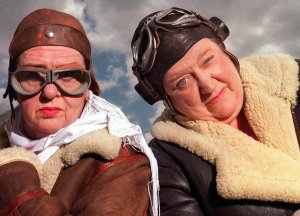 Oh yes and for me, my motivation or my model was the Two Fat Ladies, the cooks. I was thinking about how obviously everything matters to them but it’s also quite mundane to them at the same time. So, they’re having fun, they’re working off each other, there’s a language they speak between themselves but they’re also aware they have to say it out loud for the listener. So I like that mix of ‘Right, let’s just get on with it.’ And basically treating killing like deboning a chicken (Laughs).
They’re rather like Callan – he was damn good at his job, which was killing.
Yes, definitely…That’s what I had in my head: this is taking the morality out of it, this is their job and they do it as well as they can. They critique each other on the way each other does their job but mostly they work together. They’re a little team and it’s like making a pigeon pie or something!
Who is Aldrich Kemp? and The Lovecraft Investigations are available on BBC Sounds now
 Doctor Who News Star Trek News
 Sci-Fi Bulletin: Exploring the Universes of SF, Fantasy, Horror and Spy-fi!