The Unquenchable Thirst of Dracula: Review
By Anthony Hinds, adapted by Mark Gatiss and Laurence Bowen BBC Radio 4, October 28, 2017 and on iPlayer India 1934: what, or who, is behind mysterious disappearances? Settle in […]



By Anthony Hinds, adapted by Mark Gatiss and Laurence Bowen BBC Radio 4, October 28, 2017 and on iPlayer India 1934: what, or who, is behind mysterious disappearances? Settle in […]
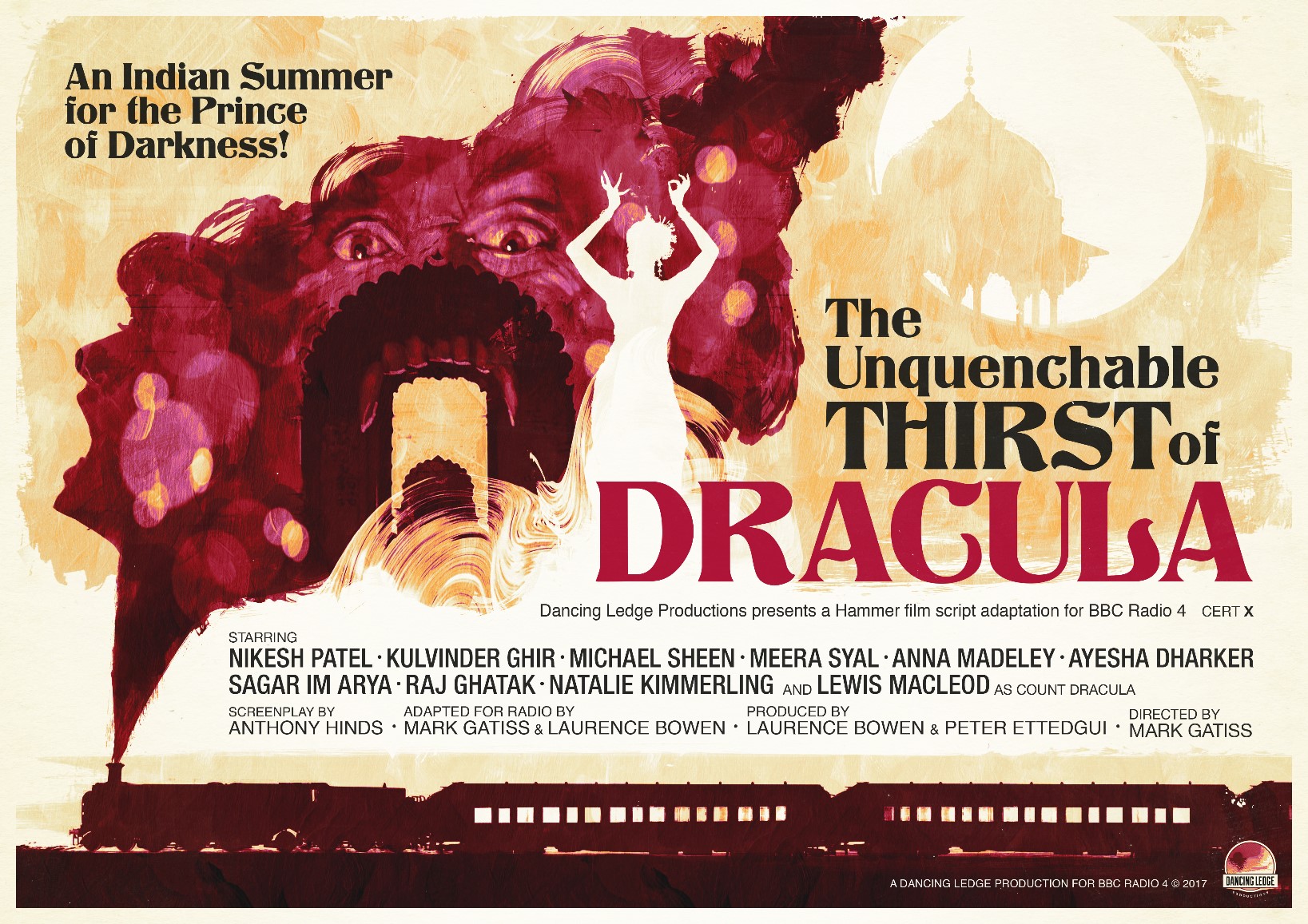 By Anthony Hinds, adapted by Mark Gatiss and Laurence Bowen
BBC Radio 4, October 28, 2017 and on iPlayer
India 1934: what, or who, is behind mysterious disappearances?
Settle in for 90 minutes of Hammer horror with Mark Gatiss’ revivification of this lost Hammer script from 1970, a time when the studio were trying to work out what to do with their most iconic figure. It’s something of a halfway house between the period adventures of the earlier movies and the contemporary Dracula – AD 1972 and its ilk, with Hammer still seeming unsure exactly how to use the Count to good effect. Although the Transylvanian lord’s presence is felt throughout the story, he’s not in it as much as in some movies – but when he is, you’re in no doubt of his power.
Lewis Macleod channels Christopher Lee’s performance as Dracula in much the same way that Tim Treloar brings Jon Pertwee’s Third Doctor to life in recent Big Finish audios – it’s not a slavish imitation, but it immediately creates a mental picture of Lee, and there are some moments after you’ve heard it where you’ll swear you saw Lee in full on vampiric mode. Anna Madeley’s Penny is not the slightly scatty character she appears to be at the start and the interaction between her and the rest of the cast, especially Kulvinder Ghir’s Babu, makes the more incredible moments in the story credible – even when facing Raj Ghatak’s malevolent Maharajah and Meera Syal’s gloriously evil Rani.
The whole thing is bound together by Michael Sheen’s excellent narration, which seems to be become more subjective as the story progresses, and that coupled with Blair Mowat’s James Bernard-esque score (with suitable inclusion of local instrumentation in a way that doesn’t feel gratuitous colour) creates a chilling ambience throughout.
Gatiss knows and loves his Hammer films, and he brings that knowledge and love to bear as director and co-writer. Anyone got another lost Hammer script he can bring to life?
Verdict: An unmissable treat for Hammer fans. 9/10
Paul Simpson
 Doctor Who News Star Trek News
 Sci-Fi Bulletin: Exploring the Universes of SF, Fantasy, Horror and Spy-fi!