The Human Frontier: Interview: Nicholas Briggs (Part 2 – Spoilers)
In the first part of this interview, Nicholas Briggs told Paul Simpson about the genesis of The Human Frontier, his new Big Finish Original series that launched last month. In […]



In the first part of this interview, Nicholas Briggs told Paul Simpson about the genesis of The Human Frontier, his new Big Finish Original series that launched last month. In […]
 In the first part of this interview, Nicholas Briggs told Paul Simpson about the genesis of The Human Frontier, his new Big Finish Original series that launched last month. In this concluding portion, there are multiple spoilers as we discuss the series in more detail. But first…
I’ll have some beer! No I won’t.
Which is something that the readers can’t see! And of course the sort of thing that we can’t see on audio.
Oh but I love that.
When we were doing The Human Frontier, we had someone in to do a bit of unofficial work experience, Heather Challands. She was very attentive, she’d read the scripts and she was absolutely marvellous. At one point she said to me, “There’s this bit where one of the characters’ face is covered in blood and he doesn’t know why. And he’s very traumatised by it. The guy says ‘Put the light on’ then ‘Oh my God, your face!’” There’s a note to the actors, you’ve got to remember his face is covered with blood. She went ‘Um, the audience won’t know that’ and I just said, “Don’t you worry. Next scene, they say it.”
The thing about audio is that you can play around with that stuff. You couldn’t do that on camera because it would be evident that they were covered in blood. You give the audience a slightly different experience because they’re thinking, “My God, what is it? Why is he appalled by his face?” You cut to somewhere else, you have a big exciting scene with a monster chasing someone and then you come back and then you find out that this guy’s face is covered in blood.
I’m not saying it’s better, it’s just that it has a different kind of impact and that is the fun of audio. You can do things like someone waggling around an empty bottle of beer, someone else making comments about it and really play around with what you hint at and leave the audience guessing. Then later on, cut to the end of interview and you hear the sound of bottle being opened and me glugging it down because I’m so desperate for a drink throughout the entire interview. (That is not the case, I’m just making up a narrative.)
 I noticed reading the scripts you’ve got directions for the actors like ‘smiles’, which you’d think you’re not going to get but actually does come across in the vocals.
Of course, if you smile when you’re talking you sound different. You have a smile in your voice.
When I first worked with Scott Handcock, I think it was when he was script editing me on The War Master, he said to me, ‘My God, you leave no stone unturned’. He said it in a tone of voice that made me feel it was a criticism so I said, ‘Oh, sorry’ and he went, ‘No no, it’s a good thing. I’ve never worked on one of your scripts. You put everything in there don’t you?’ and I said yes.
Now, this is anathema to a lot of TV and film people. They say, leave it open to the director’s interpretation, but I’m very much into the writer putting in as much as possible. The director can always ignore it but I stick it all in, let them know, let them be in no doubt because the worst thing for me as a director of audio is when I get a script and I look at it and I think, ‘You’re not telling me what this scene is supposed to sound like’. You need to tell me that because I don’t want it to be a Magical Mystery Tour; I haven’t got the time for that.
I even put music cues in my scripts; not for all the music cues but if I think this scene will be improved by a music cue just here when someone says a particular line, I’ll put it in. I usually give each music cue a title. Sometimes they have titles like ‘Oh my gawd’!
Just sidetracking there, I understand entirely the crew of the Frontier saying, ‘Oh my God’, but why are the people on Triton still using it?
I think it’s something embedded in human culture.
But it wasn’t 30 years ago: we didn’t grow up with that being said.
What? “Oh my God”?
Not in a common way… you’d get a clip round the ear.
It was naughty, yes, a very Bad Thing. It was quite a thing when in Doctor Who, the Doctor started saying, “Oh my God…
I noticed it when Chris Eccleston said it for the first time.
 That’s an interesting general point because one of my original ideas was that there would be a language difference, because of what I was talking about [in part 1]. If we went back in history 300 years our biggest problem would be language. Talking English to someone 300 years ago, the form of the language would be different. The accent would be so hard. They wouldn’t know what we were talking about, we wouldn’t know what they were.
I wasn’t going to create a new language, but I was going to use different kinds of vocabulary for the people who are further in the future, because we keep simplifying all our grammar and all our vocabulary and reversing the meaning of words.
I was going to have a lot of fun with that but then I thought that was a separate drama in itself. It would be a language drama and it would be such a massive thing to do. I thought, “I’m not really clever enough to do it, unless I spend years writing it.” So there’s a little bit of artistic licence in the way people express themselves; I’m using shortcuts.
Funnily enough I thought I was going to use a lot more bad language. We put a warning on it saying it’s for adults and there’s an S.H.1.T and there’s a couple of other naughty words in there, the one beginning with W. But I suddenly felt a bit coy about it, I thought “This is going to be a bit distracting, isn’t it, with people just saying swear words.” It would sound a bit juvenile.
To me it’s not juvenile, it’s jejune, the writing people do when they think they’re being grown up. You’ve got to talk about sex, you’ve got to have a four letter word in there because “that’s what adults do.”
Ultimately I just didn’t think the bad language thing was useful to me. I just think every now and again when something really bad happens I don’t want someone to say “oh bother”, “oh gosh”. I think it’s much better when they can use an S word.
The two circumstances where I miss using extreme language in a Doctor Who are when someone is being terrified or attacked or if someone is really annoyed about something. Those are the two circumstances in which non swear words sound a little bit inadequate.
Let’s talk about the characters on Triton. The relationship between the president and the special advisor it reminds me of the lovely relationships in The Caves of Androzani.
Yes, I suppose that must have been an influence on me.
 And particularly, I was waiting for a sort of turn to camera and the little asides.
Yes, Malden Grey makes little reports to himself, doesn’t he! All these things… on a subconscious level, I’m probably regurgitating lots of Doctor Who. (Laughs)
What was it about that dynamic that helped the storytelling? Because you could have easily had the president without somebody with that close contact. We learn later on that they grew up together, best friends.
Well, not necessarily best friends but they certainly grew up together.
Would you not have somebody you trust implicitly in that role? Knowing all your secrets bar those one of two little things…
Well yes, the whole trust thing… I don’t know how much “like” there is but there’s great familiarity. But I’ll tell you the very dull reason why I did that.
The budgets for the Big Finish Originals are extremely small, so I have to find a way to worldbuild with a minimum number of characters. I love challenges like this. You could argue that it would be more realistic to have a situation on Triton where you have a president and their various heads of department that he deals with on a daily basis, that he talks to different people on communicators, has different people report to him, has one assistant who covers all that and there’s maybe an office that that assistant is running. But what I’ve done is condense the whole of Triton’s society and government process into one person who works with the supreme political power.
Once you do that in order to solve your practical problem, you then start to say something about the fictional world you’ve created. You make it more totalitarian, with all power concentrated in such a small group. They keep secrets from everyone and they’re plotting and doing terrible things.
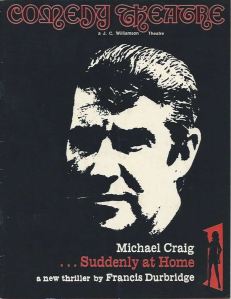 It’s necessity being the mother of invention really. On audio it’s very good. The old radio writer Francis Durbridge wrote lots of thrillers for the stage. As rep actors we always used to joke about Francis Durbridge plays: you’d have two people on stage talking, and if someone else came on, you knew that one of those other two was going to leave, or the person who came on was going to go almost immediately.
Francis Durbridge was brought up writing for radio – and radio in those days had quite poor sound quality where it’s difficult to differentiate between voices – so mostly he just had two people speaking because then the audience are clear who’s there. Once you have three and four people speaking, if the sound quality isn’t that good you start wondering who’s talking. That is why old radio drama you have the person who talks in a very low voice and the other person talks in a high voice. They had to have very different voices.
Even with fantastic sound quality there is an element of that because people are very visual and they’re not quite so adept, when they’re new to something, at differentiating between different voices. I would argue that a lot of Big Finish listeners have got very adept at it.
It’s also just very powerful to have two people talking because you can differentiate between them easily and it gives them a closer personal relationship. So you’ve got one major thing to focus on, to get all your emotional and plot information across.
I suspect Robert Holmes was embracing the same idea.
Exactly because he didn’t have the budget for loads and loads of characters on Androzani Major.
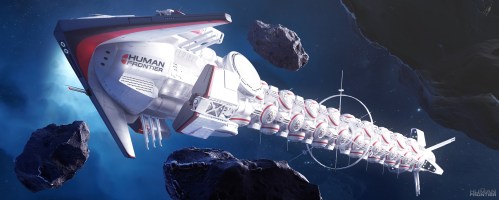 There’s a lovely feel, particularly in episode 3 of a sort of Florentine Medici consigliere that really makes that work. Then we get into far more of an attitude of “We’re going to blow the bastards out of the sky…” The final part feels a little light on the subtlety…
This is what happens in an escalating situation, in any world situation. Subtlety eventually disappears when people lose their patience, and I think that those two governing people on Triton lose their patience with the situation. All they see is threat and so they want to act upon it.
The people in the Human Frontier are desperate to get Anna back. Their person who for one reason or another (as far as they’re concerned they don’t know why), has been deposited on the planet, and they want to get her back. So they try to phone them up, the people on Triton won’t answer the call; they send something down to have a look and they blow it up. So the people on the Frontier think, “Hold on a second,” then they get messages from Anna’s A.I telling them basically that the Tritonites are trying to make a hole in Anna’s head to get the A.I out of her.
That to me is what the process of drama is: it’s escalation where all the reasonable options start getting kicked out the window. My aim was to create a drama of the clash of two cultures, of misunderstanding.
Anna keeps saying to them that her friends on the Frontier are not a threat, why would they be a threat? “What will they think now?” the Tritonites ask. “They’ll think you’re being aggressive, that’s what they’ll think,” Anna tells them.
The process is of less and less understanding from the two parties and them ultimately coming to blows. Otherwise, I could have done a drama where ultimately they just sat down and had a cup of tea together and said, “Oh actually, you’re quite nice”. But that’s not what the point of this drama was. It wasn’t a “sit down and have a cup of tea” drama, it was an “Oh my God everything’s going to escalate and people will die and things will blow up.”
Yes and you weren’t doing a drama like [Jon Pertwee Doctor Who story] Frontier in Space either where you’re picking up 20 years after that confrontation. Or Babylon 5’s In the Beginning.
 Yes Babylon 5 just came to my mind as well. Why would anyone create a story and stick the most dramatic thing off stage? You wouldn’t believe the number of writers who do that. I’ve read many scripts when they’re essentially saying, ‘Oh look! There’s an interesting thing that’s happening over there!’ And my instant response is, ‘But we’re not there! Let’s go over there!’
Now, that is the reason by the by why I tell the story in such a strange order. There are two things: I want to make it a little bit like human consciousness, because we don’t experience things in the right order. We’re constantly thinking about the past and wondering about the future and we’re visualising what’s happened. So if you could put some kind of 3D recorder inside our brains to work out what we are seeing/thinking all the time, it would not be chronological. It would be a total mishmash.
The other thing is that there’s a real curse on epic stories. It takes a long time for anything to happen and I’m a big fan of stories that hit you straight in the face with something happening right at the beginning. That first episode is full of crisis after crisis isn’t it? That’s what I wanted to do. The story sort of settles down in episode three but then it gets back up to speed again.
I like fast music, I’m an impatient person. I like things to happen quickly, I can’t be bothered fannying around waiting for stuff, I want it now.
That’s what I wanted to do with this story: set two people on an alien planet, one of them takes off their space helmet and the other goes “Oh my God” and before you know it they’re kissing and wow we’re into the theme tune, and the next thing is someone seems to be choking!
That form of storytelling has obviously had some recent prominence with Westworld.
I’ve only watched the first series
Even the first series you’ve got the different time periods. I did wonder if that had been an influence?
I’m sure it must have been subconsciously. I can’t even remember what happens except that when I got to the end of it I thought, I don’t think I’m going to watch any more of this. When something becomes just wilfully confusing, I lose patience.
 So how do you as the director make sure that the listener doesn’t have exactly that reaction? I’ve had the benefit of reading the scripts, I know when we’re in flashbacks and going forward, everybody else doesn’t.
Yes, that’s interesting, isn’t it. I use all sorts of things like reverberation but they’re all written in the script for the sound designer to do. Actually at the music stage I added in some sort of strange electronic glitchy noises like reality was jumping a groove. I felt we needed a little bit of an extra indication that we were jumping time tracks.
You sort of answer the question with the fact you felt you needed to do that.
Yes I did need to do a bit more but in line with the comment I made a bit earlier about whether or not you knew someone’s face was covered in blood, I don’t mind if people are momentarily confused by something, as long as the payoff comes along relatively soon.
As (name-drop clang!) Steven Moffat said to me, ‘About the only power you have as a writer is the order in which you tell your story’ which is why he objects to spoilers because he said ‘By spoiling my story you’re ruining the order I want to tell it’. It’s like you’re telling someone a great anecdote but some berk’s already heard it before and they go, ‘Oh yeah that’s when they all fell over’ and you go, ‘Yes that’s what I was going to say in about ten minutes time. So I’ll just go now shall I?’ It is your right to decide what order to tell it in but you also have the duty to give the audience – in my view and this is possibly where Steven and I disagree – you have to reward them with the bleeding obvious quite often.
When I’m reading or watching or listening to something, I need a bit of the bleeding obvious. If it’s all too convoluted and all a question mark then I lose patience with it. As I’ve indicated earlier, I have no patience. I lose patience with it quite quickly.
I think there’s a lot of weird stuff going on in The Human Frontier, especially in the first episode, but for want of a better phrase, it strings itself up relatively quickly and the narrative jumping around starts to thin out as we go through episode 2 and is virtually gone by most of episode 3 and 4.
Episode 4 has some scenes set in the future though doesn’t it?
Yes, that’s true.
The A.I. Nilly obviously gives you a lovely practical way of having characters not talking to themselves all the time. Was that where the idea came from? Obviously there is a conceptual element to this involving what Nilly’s done, and whether you believe her or not, and I think you carefully leave that up in the air to an extent.
 As you can see in my previous answers I’m quite willing to admit that practical things drive creative decisions, but in this case it actually wasn’t.
I was rather preoccupied with the idea that people of the future would have an even closer relationship with technology. Let’s face it: every morning we get up and we turn these computers on. I’ve got my computer here, my phone, I’ve several computers that do different things. I’ve got my iPad for reading scripts off – my whole life, even when I’m active and running around the place, is all about which device I’ll have.
I wanted there to be something very different and futuristic about the people on The Human Frontier, which we end up contrasting with the people on the planet Triton. It was actually an ideas based thing. It was only during the process of writing it that I thought, “This is actually quite useful, they can have conversations,” and then working out who could hear what.
It all came out of conversations I had with Jamie Anderson. He’s very interested in future technology and he and I chat a lot about stuff like that. I said, “Computers in people’s heads – is that what people are thinking about for the future?” And he told me about augmented reality, where you have what the computer is showing you superimposed on your reality, but you can control it. It’s rather like a more solid version of daydreaming, where you can visualise it in front of you. You could just call things up or put them away whenever you wanted to.
But the whole question that always comes up with issues of future technology is: how much is it driving the person rather than the person driving it? These devices that I have, how much are they controlling my life? I know they don’t speak, they could nudge me in the morning and wake me up but I have them set to do that, they’re not controlling me in that sense. But so much that I get from them shapes my life: what I read on them, what I watch on them.
So inevitably that question comes up in The Human Frontier, especially from the point of view of the people who don’t have these things in their heads. That again becomes a fundamental point of difference. Like the difference between us and the people from Shakespeare’s time, these people are divided; it’s almost like the people from the future find the idea of an implanted A.I to be like a blasphemy really.
Your earlier analogy about you and I going back to the 1960s: we would know where to find things out because we grew up learning how to use that stuff.
We’d go to the library.
But our children…
They’d have no idea
 Is this something that…
Preoccupies me? Yes.
It is something that preoccupies me, the whole business of control. The older you get and the more you work, and the more you interact with more people, there’s this whole business about people seeking control. Who is in control? It’s actually what human beings are all about. We’re all trying to control in some form or another. Every philosophy – I mean political or religious philosophy – is in my view and in many other people’s view I’m sure, created as a means of controlling what we think. What we think is bad in society. What we think is good in society. And each philosophy tries to assert its own superiority or control over other philosophies. And when people don’t agree with whatever idea or philosophy, you try to exert control over them. ’No, no, these ideas mean more than your ideas.’ So we try to control those who dissent. We make it illegal for them to express themselves or categorise what they think as ‘unthinkable’. It’s all about controlling the narratives, the philosophies, ultimately about controlling reality.
It’s a little bit depressing isn’t it really? But I don’t mean it to be. That’s why I put a lot of positivity in The Human Frontier. There’s a lot of positive emotion in there.
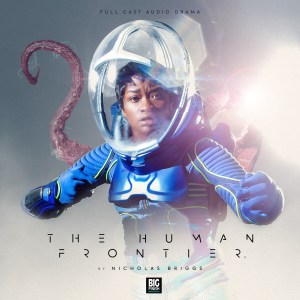
The Human Frontier is out now from Big Finish,
with part 1 currently available to download free
and the first part of this interview with Nicholas Briggs here
 Doctor Who News Star Trek News
 Sci-Fi Bulletin: Exploring the Universes of SF, Fantasy, Horror and Spy-fi!