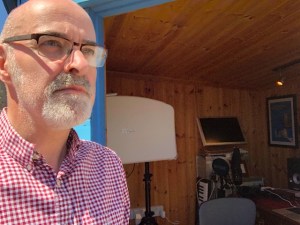
Big Finish Creative Director and Executive Producer Nicholas Briggs is the creator, writer, director and composer for the latest Big Finish Originals story, The Human Frontier. Shortly before release, Briggs […]
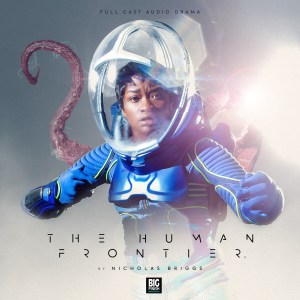
Big Finish Creative Director and Executive Producer Nicholas Briggs is the creator, writer, director and composer for the latest Big Finish Originals story, The Human Frontier. Shortly before release, Briggs chatted at length with Paul Simpson and in the first – spoiler-free – part of this interview, he discusses the roots of the drama and the challenges of its creation…
Where did the original idea of doing The Human Frontier come from?
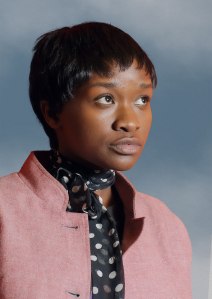
Genevieve Gaunt as Commander Daisy Bailey
When we planned to do the Originals we started totting up the original ideas that different contributors to Big Finish had and I said “Look, if we’re doing a series of Originals I absolutely want to do my thing.” I had several ideas bubbling around in my head, as I do all the time. I had in mind the kind of thing I wanted to explore and because science fiction is a great love of mine, I knew I wanted to do it in a science fiction context.
I quite quickly came up with the title and said, “This is the kind of thing it’s going to be.” Then of course I was distracted by the many things I have to be involved in, so it did keep being pushed back every so slightly. David Richardson, the senior producer, kept offering me a later slot because he wanted me to do other things.
To be blunt, when there are really headline grabbing Doctor Who things to be done, usually I am deployed to be involved heavily. And since that is our biggest product, I have to be sensible about the business and get on with that as a priority.
Was the idea behind the Originals in the first place to try new ideas out that didn’t fit within the franchises that you’ve got?
Definitely, it sounds like a marketing phrase but it was absolutely sincere. (That’s not to say marketing isn’t sincere!) We came up with the name Big Finish Originals frighteningly late in the day and it’s not a particularly original title either.
We wanted to celebrate our creativity. David Richardson made the point that every time an anniversary comes up, we always look to the past. He said, “Why don’t we look to the future? There have been so many times where we kept talking about the origins of Big Finish and what we’ve achieved and proud of all the brilliant people we’ve worked with over the years. Can’t we point to the future? Can’t we say, we’re creative people, we’re a creative company. Here’s something entirely original, that we’re going to do.’ It was celebrating anniversary in a looking forward sense.
Human Frontier – obviously there is an association with the word frontier in science fiction that is hard to get away from…
Star Trek, you mean? (laughs)
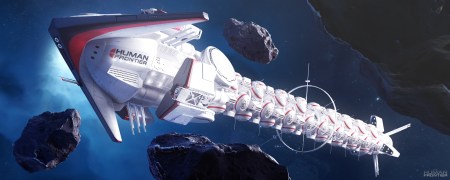
Exactly, the final frontier. Did you ever consider changing the title? Or changing the name of the ship? Which for those who haven’t heard the series yet is also The Human Frontier.
No, I was really happy with the title, not because it sounds like Star Trek (although I am a massive Star Trek fan). I was looking for something that sounded massive and important, like it was significant to the human race. I wanted it to be about the human race going further into space than they’d ever been before… oh (laughs) I realise I was paraphrasing there! And of course you just come up against the word frontier: pushing back the frontiers of science, pushing back the frontiers of human experience. It’s an evocative word.
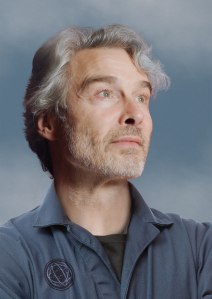
Clive Wood as Brett Triton
Of course I’m not completely blind to the fact it’s a word that’s been employed in Star Trek and I suppose in a way it signals to people that it is a space adventure. I was most concerned with the accuracy of the title in terms of what I wanted to talk about. That sounds a little bit portentous and pretentious but I wanted to talk about what I felt were the strengths and weaknesses of human beings and the reason why we’re such great survivors – and also the reason why we’re great malcontents and always having trouble with each other.
It’s this idea, which I find quite a seductive one intellectually, that the reason that Homo sapiens succeeded over other forms of human beings at the beginning of evolution for our species was because basically we’re able to come up with a good old fib.
Apparently it was just a quirk of DNA development, a quirk of genetic development through evolution that we developed this ability. But it basically meant that even though, say for example, the Neanderthals were much better hunters, stronger than us etc., they could not conceptualise an idea to band people together. All they could think about was hunting and killing and doing it well, whereas human beings could make up stuff like “We are the best hunters in the world, the sun shines down on us and we give thanks to it” and that meant they were able to band together far greater numbers of people, which makes you a more successful species.
That has been the great thing and the downfall of the human race because different strands of Homo sapiens come up with different fictions – or to use a less contentious word, narratives. We all have a narrative in our lives; when we say “fiction” it sounds like we’re dismissing it and that’s not necessarily the case.
One of the greatest fictions or narratives of modern western civilization is democracy. Now, to say that democracy is a fiction sounds derogatory like I don’t think it’s a good idea. I think democracy is a fantastic idea, I’m a huge fan of it, but it is something we made up and said it was important so we all decided, to a large extent, to agree on that.
That’s what fascinates me about human beings: we’re all creating narratives all the time. I’m creating one now of my thought process.
Pepter Lunkuse as Exographer Anna Swift
Especially as a Doctor Who fan, I was fascinated by the idea that Doctor Who always rather gently characterises encounters with the past. They meet people and they’re all a bit funny wearing funny costumes, and have slightly different attitudes. It’s all very “Dearie me Doctor, we don’t believe that because we’re from 1852 or whatever” but actually it seems to me that were time travel possible, being displaced from one era to another would be completely traumatic, and probably quite violent and unpleasant.
If you or I were just to suddenly appear in 1960s London, I think, after the initial “wow cool I’m back in time”, we would start to find it intolerable. The prevailing attitudes would be so sick-making to us and they would find us to be really weird and quite offensive. Imagine if it was 300 years’ difference…
And that’s aside from the language difficulty: the fact that the English language is at a completely different stage of development. I have enough trouble talking to people in their 20s because their language is very different to my linguistic assumptions. So I thought, what if I characterised this in a science fiction way and pushed it into the future?
I’d had this idea in my head – which I’m sure is not entirely original – of what might happen with two forms of space travel. Someone loses their patience and says, “Listen, we can’t travel very fast, but let’s put people in this space ship and put them to sleep and they’ll travel a long long way and when they wake up they’ll have arrived somewhere we think is great, to colonise a planet.” But while they’re making that journey, the human race develops faster than light travel so that when they wake up at the other end, the people in the spaceship find a bunch of people who have already been there for hundreds of years. The added thing in my story is that neither side knows about the other.
The idea was to find two strands of humanity who have completely different narratives about what it is to be human and the fireworks that would happen when they come together – or not.
The characters (or at least those we see) on the planet they land on, Triton, are not necessarily humanity at its best shall we say..
But they’ve had a tough time, they’ve had a rougher life and they’ve struggled for survival.
They’re on a human frontier as well, true. Did you work out the details of the society before the plot or did you plot it then retcon to work out how the society could have got to the point you needed it to be?
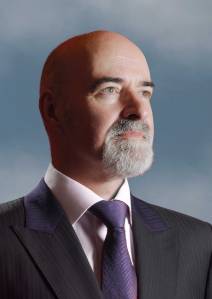
Mark Elstob as Robert Harrigan / Malden Grey / Oliver
I had some basic ideas beforehand that I got down about the society on Triton, which I’m aware is also the name of a moon of Neptune but that gets dealt with in the story.
To go back to my source material in life Doctor Who, I’m a great believer in the old Robert Holmes principle of the tip of the iceberg. What you do is you invent really interesting iceberg tips that suggest a load of other ideas that you have at the back of your mind. I work things out in a story as I need to work them out, I put a few pointers as to where they should go. I like a story to surprise me as much as it surprises the audience.
One of the interesting processes for this was working with Scott Handcock as the script editor. I said what I wanted to do here was not tell him anything about this and send it to him an episode at a time and, as well as giving me all his script editing comments, I wanted him to tell me what this episode is about. That process as we went through episode by episode, informed me.
Sometimes Scott would come back and say, “Well obviously this, this and this is happening” and I’d say to myself, “That’s not actually what was happening and either I’ve got to put something in place to make sure that’s not the impression I’ve given or maybe I’m going to go with some of this.” And there was a tiny bit of me seeing what Scott was thinking was happening that I thought might be more interesting.
It was a fantastic relationship. Scott is a great problem solver to work with in every respect actually, as a producer and a director and as a script editor, and he was solving little problems for me. He was utterly committed to the project along the way.
Did you know the ending before you started writing?
Nicholas Briggs as Hans Dendrick
Yes, I did. Funnily enough I didn’t quite end it there, I sort of suggested the ending that I had in mind as the absolute ending of the story. I did what I often do which I’ll confess now: the ending is more of a question mark than an ending. But I find absolute endings where things get tied up completely are ultimately unsatisfying for everyone concerned.
They’re dissatisfying for the author because she or he feels like they’ve killed something and it’s all over, but they’re also dissatisfying for the audience. The moment an audience engages with any form of narrative they start to create expectations of where it’s going to go and they want those expectations to sort of be fulfilled although they want to be surprised as well.
That’s the secret of writing a sequel.
Yes (laughs). But the likelihood of you ever coming up with something that would already be in their mind which would satisfy them in that sense is very slim. So more often than not, if they’ve invested in your story they are not going to like the way that you end it.
On the other hand, if you do exactly what they want, they also find that disappointing because they want to be surprised. They want the storyteller to be cleverer than them. There are a lot of clever people out there and I’m sure a lot of them are cleverer than me, so my sleight of hand is to not give them an ending at all really, (laughs) but to give them the possibility of something else. You tie up a few things but there are big question marks at the end of this, I think that’s fair to say.
I wondered if it originally had an extra episode and you pared it back to stop where you stopped. Because there was that feel that you had more there.
No, it was always planned as four parts and there’s no missing episode. The ending gives me so many possibilities to do the obvious thing and carry on the situation that we reached at the end, or there are many other things that are mentioned during this story that I could go and do a story about. Parallel things, things that happened a while ago that we don’t quite know the truth of. All that stuff, what happened on Earth…
Lucy Briggs-Owen as Nilly
One of the things that this gets into is a fake news narrative. If our trusted source is in our heads, do we still believe it?
It’s just down to who you sort of prefer on a basic human level; a lot of the time, who you believe. And likewise that’s this story. You’ve got the people on the Human Frontier and the people on the planet Triton. I think a lot of people will think that I’m saying that the people on the planet Triton are the bad guys and the people on the Human Frontier are the good guys but I don’t think that’s necessarily the case.
I certainly think that the characters on the Human Frontier are a lot more outwardly appealing and you get to hear more about their feelings, specifically two of them, Anna the exographer and Daisy the commander. But is that so? They’ve just been through a different series of experiences and at the end we don’t really know who’s controlling who.
That’s why the last episode is called Control. Everyone, even the nicest person, is seeking some level of control. Because otherwise, life is unfathomable and intolerable. You’ve got to control something, whether it’s which television channel you watch or what time you get up in the morning. We’re all trying to control our lives in some way so it doesn’t become chaotic and random. That’s what we’re all fighting, the chaos.
How challenging was the writing?
Because I do too much, the actual writing of this got put off and got put off – not in a sort of dreading it way because the ideas were building up in my head. I would think about them quite often and scribble ideas in notebooks. But I kept thinking, “I can’t write it yet because if I write it now, I’ll be too busy to do these other five things I’m meant to be doing.”
When I finally had set aside the time to do it was also when I absolutely had to do it and so I had to do that thing, which unfortunately I’ve proved to myself is possible, which is to write an awful lot in one go. And once you’ve proved it’s possible it’s like learning to write drama. I always say to people who want to be a dramatist or a writer, “learn to finish things because to start with you just don’t know it’s possible”. You think “Oh God, where’s this going to go? Who’s going to be interested in my ideas?” and you just don’t finish it. But once you’ve put yourself in a situation where you have to finish things, that’s when you really learn, in my opinion, how to be a writer. I learned it when I did those Audio Visual Doctor Who plays all those years ago, where we had to finish stuff because we had a nasty little chap poking us with a stick saying you’ve got to finish it!
With The Human Frontier, it was that mad thing where I go into my shed, at 8 o’ clock in the morning and apart from going to the loo, stagger out at 8 in the evening. All you’ve been doing is having ideas and talking about spaceships and people and monsters and maybe someone in love. You’ve not been cracking coal out of a coalface, you’ve not actually been doing a proper job, but when you have to relentlessly create like that, you stagger out like Jon Pertwee did out of the TARDIS like Spearhead in Space (laughs). You feel like you’re going to crash down. It was a couple of months, the actual writing of the script. I put myself in the punishment chair so I’m not complaining. I didn’t want to put the release date back any further because it would just go on forever!
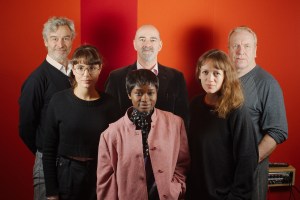
I said to the producer, Emma Haigh, “We’re going to do it on these dates and we’ll just find whoever is available on those dates. Here are the people I want.” Some of them were available, some of them weren’t but I’m very very happy with the casting.
That’s the wonderful thing when you’re doing something that’s not a franchise that relies on fixed casting. You can just cast who you want and who’s available. It’s a great feeling of freedom. I got a lovely cast and we worked solidly for four days. Normally, I would have a day off in the middle at least, or do two days one week but four days solid. That’s only four days work I know but it feels like four months!
We all say when we grow up we’ll get a proper job and there we are, in our fifties, going “Yes, we will get a proper job one day…” not happening!
It’s creating narratives isn’t it? And actually that’s what a lot of people do in their work anyway. Everyone’s telling a story in their job, in some form or another. Anyway…
In part 2, coming next week, we get into spoilers about the characters on The Human Frontier and the planet Triton.



 Big Finish Creative Director and Executive Producer Nicholas Briggs is the creator, writer, director and composer for the latest Big Finish Originals story, The Human Frontier. Shortly before release, Briggs chatted at length with Paul Simpson and in the first – spoiler-free – part of this interview, he discusses the roots of the drama and the challenges of its creation…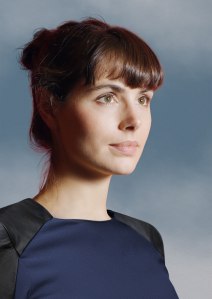
 Human Frontier – obviously there is an association with the word frontier in science fiction that is hard to get away from…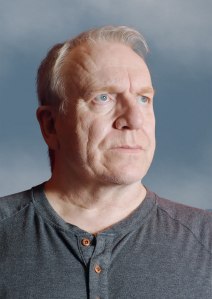

 Because I do too much, the actual writing of this got put off and got put off – not in a sort of dreading it way because the ideas were building up in my head. I would think about them quite often and scribble ideas in notebooks. But I kept thinking, “I can’t write it yet because if I write it now, I’ll be too busy to do these other five things I’m meant to be doing.”
 I said to the producer, Emma Haigh, “We’re going to do it on these dates and we’ll just find whoever is available on those dates. Here are the people I want.” Some of them were available, some of them weren’t but I’m very very happy with the casting.
 In part 2, coming next week, we get into spoilers about the characters on The Human Frontier and the planet Triton.
 Sci-Fi Bulletin: Exploring the Universes of SF, Fantasy, Horror and Spy-fi!