The Haunting of M R James: Interview: Neil Brand
Dramatist, composer and author Neil Brand’s latest radio work comprises six plays by or about Montague Rhodes James, the celebrated antiquarian and ghost story writer. Five 15 Minute Dramas were […]



Dramatist, composer and author Neil Brand’s latest radio work comprises six plays by or about Montague Rhodes James, the celebrated antiquarian and ghost story writer. Five 15 Minute Dramas were […]
 Dramatist, composer and author Neil Brand’s latest radio work comprises six plays by or about Montague Rhodes James, the celebrated antiquarian and ghost story writer. Five 15 Minute Dramas were broadcast in the week before Christmas, culminating in a one-hour original play by Brand about James himself. Mark Gatiss plays James across the series, and in this short interview, Brand told Paul Simpson about working on the adaptations and the new play…
Which came first – the 60 minute play The Haunting of M R James or the idea of a season of dramatisations?
I took the idea of the play to the Commissioner of Radio Drama, Jeremy Howe, and he suggested linking five of the story adaptations to an overall play on the Saturday. I had always been fascinated by MRJ and his world (indeed had written a movie script, Half-Light, with him as a central character, set during World War 1, a very different beast to Haunting) and wanted very much to understand where the extraordinary ability with terror had grown within a mild-mannered Antiquary. I had read the superb biography by Michael Cox, and some more recent and more academic texts, and was granted access to both Kings and its current Provost, Michael Proctor (who still maintains the ghost story tradition by candlelight) so the world was pretty detailed in my head before I set out to drown Davey Steadman.
 How much did they feed into each other creatively – for the play did you know which stories were going to be ‘linked’ from the start?
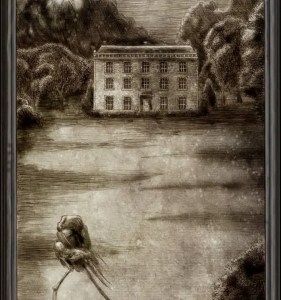
I knew the supernatural element of the story would trace a Jamesian line and go from tiny details changing, to the idea of being cursed, to the Provostship, to the awareness of a pursuer, to a final denouement away from Cambridge – then picked the stories that seemed to best trace that path. I also wanted to run the gamut of styles within the genre, so Runes becomes a race against time, Rats is an out-and-out haunting, Mezzotint is about inanimate objects changing, Barchester deals in the fascinating world of Church hierarchy and Warning to the Curious is an amalgam of all those.
Interestingly the play features Mark reading the end of a couple of stories which finish slightly earlier in the dramatisations; was that deliberate or just happenstance?
I wrote the play first, because I knew that was my way into Monty, and it was one of the hardest things I’ve ever written – he ran through my fingers time and again, and the more research and reading I did, the harder it became to pin him down. I also moved house during the course of writing it which blocked me for a month. My wife and the play’s Producer, David Hunter, helped me through that horrible blockage, and David gave me wonderful places to go to develop the story – Thomas Herrick is much more ‘flesh and blood’ because of David, and all the better for it. I had thought that I would definitely include the opening and closing lines of the stories in the adaptations but when the time came to write them I didn’t have that luxury – but I thought it made sense if the Monty of Haunting did properly complete his stories.
 When did you first read James’ stories, and what effect did they have?
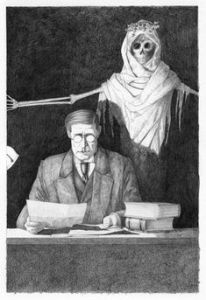
At school, in my teens. They had a huge effect on me, largely because I hadn’t read anything of that antiquity which made me feel the writer so close by my side – I could hear Monty’s voice when I read them, and I think that’s another reason why they work so well. In an odd way they have the page-turning quality of a good detective novel, because you know the ghost is there, that it has a mission, so you search out what it is, why its there and try to guess (with dread) what the outcome will be – but the sheer horror, and pictorial quality of James’s writing (“put its arms round my neck” is one of the most fearsome moments in all literature) was unmatched in anything else I read at the time, no matter how comparatively modern.
How involved creatively was Mark?
I went to Mark first (and only) back in the Spring – I had met him while he was working on his TV doc on James, and shooting The Tractate Middoth and he was delighted to do it. He was touring with the League of Gentlemen then going straight into Madness of King George, so we held off the studio until late November, when we knew he would be available, which gave me much more time to write the play – but because he ‘was’ my Monty, every line I wrote I could hear in his voice, I could imagine him doing the part (that he did it infinitely better than I’d imagined should come as no surprise!) and that too helped immensely to ‘ground’ the play.
What was the biggest challenge of both the play and the dramatisations?
 As regards the play, the biggest tangle in my mind was whether I was writing a historical drama about a 1905 academic, or a muscular ghost story. With David and my wife’s encouragement I plumped for the latter, imbuing it with as much Jamesian detail as I could, but it changed a great deal through its five drafts. (Maynard Keynes was in an earlier draft)
The challenge with the stories was twofold. As you’d expect, time was of the essence – 15 minutes is very tight so I used a narrator (something I usually avoid) which also allowed me to have Mark involved throughout; also, James’s own words can’t be bettered when it comes to descriptions of horror. The other challenge was to make them radiophonic. Ghost Stories should be the best radio drama, and I was determined to creep out the listener as much as possible with all the tools at my disposal – hence, water imagery running all through Haunting (our studio manager up to her knees in a tub of water), the breathing, the footsteps, the thumps, the screams, the running feet – somebody praised the adaptations for foregrounding the muscular nature of the tales, and I’m proud of that. James’s prose is wonderful, but for people who don’t know him or his work, who I assume to be my audience, the hook of the stories is in the plight of the protagonists, and that always makes wonderful, gripping drama.
Were there any stories that you wanted to incorporate into the play and/or dramatise that you weren’t able to?
No, I hope very much to get the chance to adapt more in the future – I’d love to see a few more dramatisations come out every Christmas! I have so many favourites I haven’t yet touched.
And finally what element of the whole project are you most pleased with how it turned out?
 I’m thrilled that the effect seems to have been to respect the original source material but to allow the content to speak for itself – I had messages from people (yourself included) who knew the stories well and enjoyed them despite the tight duration times, which gave me a huge feeling of relief; and messages from others who had been driving late at night when they came on the radio, and then had to fumble for a door key in the dark, minds racing with possible horrors. I’m sure that was MRJ’s ambition, too – the warm dread of imagination, the Christmassy thrill of peering into the darkness beyond the firelight and actually feeling something rising up that shouldn’t be there. I was thrilled to get to write these plays, it’s the icing on the cake that people have liked them and that I don’t seem to have busted the delicate machinery of the classic Ghost Story!
The five plays can be listened to here on iPlayer
And The Haunting of M R James can be heard here.
The individual play reviews are linked in the text above
 Doctor Who News Star Trek News
 Sci-Fi Bulletin: Exploring the Universes of SF, Fantasy, Horror and Spy-fi!