The Grey Man and Other Lost Legends: Interview: Sebastian Baczkiewicz
Sebastian Baczkiewicz’s latest play The Grey Man and Other Lost Legends aired on April 14 on Radio 4 – a unique blend of folk mythology and genre tropes that constantly […]



Sebastian Baczkiewicz’s latest play The Grey Man and Other Lost Legends aired on April 14 on Radio 4 – a unique blend of folk mythology and genre tropes that constantly […]
 Sebastian Baczkiewicz’s latest play The Grey Man and Other Lost Legends aired on April 14 on Radio 4 – a unique blend of folk mythology and genre tropes that constantly surprises the listener. The creator of the long-running drama series Pilgrim chatted with Paul Simpson about it just before Easter…
NB There are spoilers for the play here – have a listen first!
Last time we spoke was about four years ago, just when Pilgrim series 7 was about to air. Quite a lot has happened since then but obviously the core thing to talk about is The Grey Man and Other Lost Legends which I found very intriguing. What was the genesis of it?
This is the sixth of my collaborations with Joby Waldman, the producer of the piece.
In 2012, I think, there was a slot on Radio 4 – there still is – called the Drama Documentary and that was nearly always, quite rightly, something very serious. You’d have documentary evidence and then a drama built around it; we were asked to come up with new ways of approaching afternoon dramas.
I wanted to do a piece that in no way detracted from the seriousness of the slot but to mainly do one that was more light-hearted. I had an idea that I pitched to Joby which was to do a piece about a joke, about a man who kept bees in his apartment in Manhattan. We went to New York and we interviewed people about this guy who lived in an apartment and kept bees. They told us a load of stuff, and out of that I made a drama. Then we did one subsequently about Heathrow then one set in Sweden, one in Miami then the latest one was in Scotland.
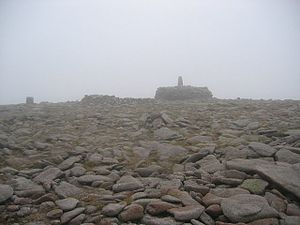
 The Big Grey Man was the myth that we were exploring. We’d go and talk to people about it, and through the conversations there was a lot of talk about how the Highlands had changed and how the Highlands had not changed, and how things remain very ancient. I’m not going to pretend to be completely accurate on this but the Cairngorms are something like 450 million years old and they represent the oldest places on Earth.
We interviewed people in our traditional way, with me having no idea what the outcomes of these interviews was going to be, and from that gradually I started to build an idea. I thought that we could have done a piece that was very bedded in the world of the people telling us the stories. Or we could look at them from a completely different angle (laughs) and that’s what I did.
And it is a very different angle! But where did the idea of the climate change and time travel elements come from?
We spoke to some people who talked about climate change and my original reaction was to use climate change but not make it about climate change.
I was trying to find a way to do it and also trying to find a way to tell a story that was intriguing and unusual – and I suddenly got an idea. One of the people told the myth of Saint Mungo [the founder and patron saint of Glasgow] finding a ring in a salmon and I wondered what myths we would have that would continue through generations. I wondered: what if a person found a diamond or a crystal in a fish now? That would still be fairly insanely unusual but also not entirely impossible.
 One of the people who features in the play, the character Magnus, came at the Highlands and the Cairngorms from an entirely unexpected direction which was as a kind of place where all sorts of strange sightings and slightly UFO-y science fiction-y style elements [happen]. I thought that this was really not what I was expecting – I try not to expect anything from these things – but I was like ‘Wow, this is like a fully fledged conspiracy theorist, lights in the sky, UFO believing…’
I felt that that was again not something you would immediately associate with the Highlands, so that should be the way to go. Things that you don’t normally associate with the subject should be the things that you use.
I was thinking more about time travel, and one of the ideas is that people who spot UFOs are actually seeing the future. Rather than seeing something from another world, it’s our world looking back at us. I thought that seems to be an interesting take on how to approach the subject: someone looking back at our world.
Originally I was reluctant to go full apocalypse but then I thought oh sod it. (laughs) This was of course long before our current crisis. I was trying to imagine what it would be like if there was the sense that these people in the future are witnessing these testimonies with a sense of “oh that’s what we’ve lost”. There’s something about the Big Grey Man and the way that that legend is about people feeling anxious and often discombobulated by the presence of the Big Grey Man.
Then I thought: Wouldn’t it be interesting if there were different archivists who were focusing on different aspects of our world in order to bring them into reality for people in the future?
 It reminds me of the stories of Ralph Vaughn Williams collecting all the country tunes when he was compiling The English Hymnal. There are just so many tunes in there that would have been totally lost, had he not gone round and got people to sing them to him. He wrote them down, created hymn tunes from them named after the villages he heard them in, and some of them are now pieces that even a non-church goer is going to recognise if it’s used in a drama.
That’s fascinating, that’s a really interesting take on it. Yes, I think that’s really close: by extension documenting and archiving a kind of folk relationship. It’s kind of folk sci-fi, yes, that’s definitely the way I was going with it.
Weatherall gets an obsession with the Big Grey Man and at times almost steps over other stuff to get to that.
That’s right. Throughout the play the whole piece is built around the fact that Weatherall mucks up the whole thing all the way through, until the end.
I wondered if you were going to be bleak enough to make her decision totally bite her in the backside.
The consequences if they both die in that cave would be that past and future are sort of fused and it’s all over for everyone. I thought that was too bleak. I thought it was bleak enough in terms of its implied background.
But I wanted Weatherall to be a flawed character and not any kind of a hero, and in fact someone who’d be warned to stop what she was doing, that this was not healthy. I think there’s a bit in the play where people just say ‘leave the past where it is’.
 One of the influences on it was back at the beginning of the year – which seems like a hundred years ago now – there was an article about people wanting to get rights to go back down to Titanic. And everyone was saying, ‘Why? Just leave it alone.’ It’s not a theme park and it’s not a Flog It special. It’s a grave – just leave it alone.
And in this the flood water is covering everything so Weatherall is literally going down to Ben MacDhui.
Yes, she has the experience of being in the waterless world, where water stays in lakes and seas and rivers and not surrounds everything.
In terms of the actual practicalities, you record interviews about the folklore and so the people talking about the folklore in the play are real people discussing the legends?
Those are real people discussing the legends, and other things too – we don’t try to proscribe the interviews too much. There are things we’re going to talk about but if they start talking about other stuff that they’re interested in then we always try to keep them talking about that too. We’re much more interested in them as what they have to contribute as characters, as it were. And we’re very grateful to them, really grateful to them for the time that they give us.
 So the only fictional characters in this play are Weatherall, Fergus and the Counsellor and that’s it.
Yes.
I really wasn’t sure how much was guided.
As I was going along interviewing people I was slowly putting the first markers in the ground and I think I said to a couple of people ‘Could you just talk about this person Fergus and just tell us a bit about him?’ and let them make it up a bit, which was interesting.
Magnus was such a brilliant and natural speaker – he also contributed music to the piece as well. We got to him through an album that he’d made about The Big Grey Man that was available on Bandcamp that Joby found. At the time he was working in a bar and we just went to interview him on a Saturday morning. Out it all flowed so we went back to interview him about five days into the process. By then I’d made a few markers in the sand so I had a few things to ask him to talk about.
I genuinely thought he was an actor.
That’s because he’s brilliant.
He’s a natural raconteur so I can see how you’d be drawn to somebody like that to do more.
We’re making a fiction, no one’s pretending this is a documentary; we’ve been very open about it. It’s just a new way.
Our way of approaching these stories is from a back to front way. We have no idea what the piece is going to be about other than it will include the mythology but we’re really going to be guided by what the folk say to us. So when you meet people who are ready to just improvise and just rap on about anything, that’s gold for us. Then I rack my brains and think a lot about how I’m going to make the piece work.
So presumably that’s using very different creative muscles than writing something like Home Front or Pilgrim?
Home Front was a show that we worked in collaboration with other writers on so to a certain degree you’ve always got to create your own kind of roadmap for the piece. And on Pilgrim, I would follow my nose but there would always be a story or a folktale that I would be incorporating into the mix of it, as it were.
So, kind of yes and no: definitely with Home Front which was a formatted show. We all knew what we were going to be talking about in each episode and worked out the storylines collectively.
Season 7 was going to be the end of Pilgrim but he has returned since then…
 I always intended it to be something that could come back. There’s so much to enjoy in the folklore and it’s a really useful way to talk about the world; at least for me it is. Because it’s set in a contemporary world you can look at some of the issues and themes of our world and reinterpret them through the world of Pilgrim or through the prism of folklore. Which is where we started off but it’s where most of these things end up in the end.
I would actually love to know what he’s doing at the moment, with lockdown. How do you think Pilgrim is coping with lockdown?
Oh he’s probably buried under a tree somewhere. (laughs)
Yes, that would solve the problem, wouldn’t it. Slightly boring 45 minutes but…
Well yeah, he’s got his boltholes so…
Do I remember rightly there’s another one coming soon?
There is, there’s one for Halloween, which I’m in the midst of making right now.
Thanks to Sean Harwood for assistance in arranging this interview
The Grey Man is available now.
 Doctor Who News Star Trek News
 Sci-Fi Bulletin: Exploring the Universes of SF, Fantasy, Horror and Spy-fi!