 Award-winning podcast Imaginary Advice recently released mini-series The Golden House, a ground-breaking interactive puzzle podcast which requires listeners to discover clues hidden within the episodes and use them to unlock secrets spread across the internet. Paul Simpson chatted with its creator, Ross Sutherland
Where did the initial idea for this come from?
I’ve had different hats as a writer over the years and I’ve made audio fiction for about six years. That was something that was completely new for me when I came into it because before then, I wrote theatre and I wrote poetry. I’d done a little bit of work freelancing working for video games and social gaming, so I had some experience in terms of creating stuff that was more interactive.
I came to audio fiction as someone who’s getting to an age where touring was getting harder. I wanted to explore this new medium and over the six years I’ve always been trying to experiment. If you look at the main feed of my past work, Imaginary Advice where I put up a new podcast every month, every single time, I changed the genre. I’m not necessarily interested in maintaining a singular format. So every single one of my past episodes could be a pilot for doing a different type of show.
I’ve always been interested in the limits you can push in this medium. Audio storytelling has been around for a long time but podcasting is this quite democratic form. It means that even though I’m an indie producer that makes podcasts in their wardrobe at home on a budget of about £5, I still get to be featured alongside big studio products.
For a long time I’d wanted to do something that was more interactive; exactly how that was going to be, I wasn’t completely sure.
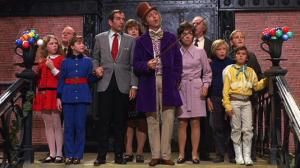 The things that came together for me were slightly varied. On one side for a long time I wanted to do something that connected to Charlie and the Chocolate Factory. When I was a kid, around 10 I was in a school production of it and I loved the book. I loved the 70s movie Willy Wonka and the Chocolate Factory, the Gene Wilder one. That’s imprinted on my memory a lot because I had a really strong relationship with my Grandad so I think I related to that. I became obsessed with it for a little while, because essentially the story of Charlie and the Chocolate Factory uses the slasher model. It’s a group of kids who go into a house and get picked off one by one.
I also liked the creative freedom of being able to design this magical realist factory where every single room is different. It feels quite video game-y in being able to have different rooms and different structures.
A lot of that stuff really appeals to the way my brain works because I tend to approach storytelling from quite a formal structural point of view. I like coming up with fun structures which then I can lead my characters through. I make architecture and I throw them into the meat grinder.
 I wanted to do something which was in some way about a factory; it eventually expanded and became a tech campus along the lines of Googleplex in California. There had been a period where this campus had shut its doors to outsiders, no one had come in and no one was going out, and inside the place had gone strange in some way. It had developed its own internal systems that had taken over and it had become a weird place for an outsider to be allowed into.
I also I fell in love with a cartoon show called Gravity Falls, which to me feel like Twin Peaks for kids. Gravity Falls is also full of secret ciphers and codes and I loved that as a way of engaging with an audience and teaching kids, episode by episode, more and more sophisticated ciphers. If you were a kid who managed to freeze frame on a cell of animation and you found a cipher and you translated it, it actually gives you clues as to something that’s going to happen in the story later. I was jealous almost of coming into it as an impatient adult who can just Google what the answers are rather than being a kid and properly getting absorbed in it and doing it properly.
 When I was also playing around with this idea, I had on my white board ‘Puzzle episode’ Usually podcasting is something I do once a week in a month, but when COVID happened, suddenly it’s the only thing I have left. All my touring work was gone, all my teaching work was gone so in terms of my life as a writer, making audio was it.
Almost in response to that, the projects that I wanted to do started to become more and more ambitious. What began as one episode of my podcast that had a couple of little puzzles and ciphers in it expanded out to being this much bigger thing where we end up with this world. It’s a six part story set in a slightly Wonka tech campus and all these puzzles strung through the series that once solved lead listeners through to a whole other shadow podcast hidden beneath the surface.
There’s six secret episodes to mirror the six main episodes and the secret layer completely redefines and changes the story as you heard it on the surface.
Would you expect people to listen to the main episodes and then find the secret versions of those episodes or have they got to wait until the end to get those?
Every time I release an episode of the main podcast, I’m also secretly uploading a secret one in tandem.
It was important to me that I gave the listeners as much freedom for the different ways they want to approach it as possible. It’s always a problem with say, puzzle video games that when you can’t solve a puzzle you are literally denied any more story. I wanted to circumnavigate that as much as possible. So if you wanted to, you could just listen to the main series and I still think it makes sense, I still think it’s optimised as a fictional drama.
Even if you didn’t go seeking the puzzles, I still think it works and that’s one of the reasons I wanted to make it also quite comedic. I wanted there to be humour in the way the story was being told, so it was still fun. Then, you can define your own level of involvement, so if you want to go deeper then you can find this whole other layer.
In terms of putting it together, what’s been the biggest challenge?
 I think that in particular, the question of accessibility, in making sure that I was never relying on any information that was contained within the secret episodes in order to understand what was happening in the main broadcast.
That’s a fascinating challenge then to create. You start to think of these stories as this architecture – one of these ancillary stories is like this wing of a house that goes off to the side but you don’t have to travel through that to get to something else on the other side. They’ve got to span out but everything has to connect back to the central hub and I think that’s a really interesting challenge as a storyteller.
It makes you realise how much any transmedia property – anything that exists across television, magazines, novellas – are all non linear because they have to exist in this world where they can be assembled in different orders without the entire weight of the project collapsing. And that’s not easy.
I presume you had to therefore plot out all six main episodes and all six secret episodes before you could actually start writing the first one? Or did you start writing and then go “Right, I’ve written myself into a bit of a corner here how do I get out of that?”
I did have an outline for what would happen but I left some sections unwritten and even as the series is airing, I’m still writing some of the final secret episodes.
Are you doing that in reaction to what people have said about the first two?
Basically. And that’s something that is a privilege of working in serial which is something that I’ve never done before. I’m used to working in standalone stories which all come out at once. It’s really interesting. I’m trying not to do the thing which often happens in serialised dramas where if somebody was to guess where I was going, that I’d veer off in another direction because someone guessed it. But I am interested in world building that the listeners are doing. I like this idea that these characters are never truly alive until they’re public; before that they are theoretical constructs.
I think sometimes other listeners see humanity in stories that maybe you wrote in quite dehumanising ways. And then suddenly they have a sympathetic take on a character and that changes things.
 You’ve got to have some misdirection haven’t you because you’re the conjurer. You are God to these characters, and you don’t want things to be too straight forward either.
No. I think if we were to classify The Golden House as a very light version of an ARG an alternate reality game, that genre of alternate reality game, they are like Apophenia simulators. They are places where we can indulge our paranoia. We delineate this space and we say, “OK, in here we’re going to remove that thrust limiter on that part of the brain that makes connections between disparate things” and of course by doing it inside of an artwork, we’re creating this safe space to play with that side of our creativity because we all have it.
Removed from the frame of an artwork of course, that way is what leads to schizophrenia, you see secret names for God written in the clouds and stuff like QAnon, which we’re seeing this huge surge in mainstream culture, this idea of mass connecting conspiracy theories.
I like the idea of reclaiming these kinds of synchronicity hunting, which is something like a creative pastime and maybe in doing so we get to exhaust our desire to do so. Which means maybe we’re slightly less paranoid in our everyday lives.
But yes you’re absolutely right, you have to have to allow for ambiguity. The idea of not knowing quite when someone is trying to secretly communicate with you and when someone is just making a non sequitur. The world has to be rich enough for you to be able to look out at a series of data points and dream yourself into them and work out what the connections are.
Is this self contained? Is there a world after episode six that you could continue if you wanted to do a series 2?
As it currently stands, yes the story does end in an ellipsis which would enable me to come back and further develop the world. What’s interesting, and what I’m getting my head around right now, is, if I was to make another chapter next year, whether it is a sequel that follows on continuously from the narrative end of season 1 or whether it is a third layer which gets wrapped over the first series.
 That’s really going to be quite alienating to a new audience, if you want to bring new people in.
You could well be right. I think it becomes more like a season 1 redux. If you were starting over fresh it would just be a richer story because there would be more layers to it. But for people who have already played it, there might not be the incentive to go back and play it again because the first two layers, you would already be familiar with.
I think what that means is when it comes to the end of this, do I think the next step is a sequel or a reboot? If this was something someone had commissioned me to make, there’s no way that I’d be able to go, ‘Oh, could I just make that again but make it denser this time? Just add more?’ They would say no and I guess that’s my advantage to self commissioning these kinds of things is that yes, I can keep going back and tinker.
Anyway, as yet I haven’t made any decisions on that kind of stuff but the good thing is that I want to leave the door open so that there’s still space.
The Golden House can be accessed here
Thanks to Ben McCluskey for assistance in arranging this interview




 Sci-Fi Bulletin: Exploring the Universes of SF, Fantasy, Horror and Spy-fi!