The Conception of Terror: Interview: Jonathan Barnes
Jonathan Barnes is probably best known to SFB readers for his new tales for Big Finish’s Sherlock Holmes range, but he’s stepped forward a century for The Treasure of Abbot […]



Jonathan Barnes is probably best known to SFB readers for his new tales for Big Finish’s Sherlock Holmes range, but he’s stepped forward a century for The Treasure of Abbot […]
 Jonathan Barnes is probably best known to SFB readers for his new tales for Big Finish’s Sherlock Holmes range, but he’s stepped forward a century for The Treasure of Abbot Thomas, his contribution to Bafflegab’s new quartet of M R James stories for Audible, The Conception of Terror (read our review here). He answered a few questions from Paul Simpson…
How did you become involved with the project?
I was contacted – rather wonderfully, completely out of the blue! – by Simon [Barnard], the director. A terrific surprise.
 When did you first read (or encounter, if it was on TV) an MR James story? What effect did it have on you, both at the time, and subsequently in your writing?
I first encountered M R James at school, both as prose and on-screen. In fact, the very first adaptation I ever watched was the BBC’s excellent version of The Treasure of Abbot Thomas! His writing’s been a huge influence on me – that very particular combination of English repression and creeping dread. I’ll read (or re-read) something by James every winter without fail.
I was able to pay a less direct tribute to the master in a series of ghost stories which I wrote a few years back for Red Raygun.
I also love Robert Lloyd Parry’s terrific one-man performances of the best of James, which has also become a bit of a Christmas tradition. Heartily recommended if you’ve not caught it so far!
Why did you choose this particular story to adapt?
It was a very difficult choice. An early thought was to adapt A School Story and there’s certainly an echo or two of that in the finished product. In the end, I went for one which I thought might fit quite neatly into the twenty-first century…
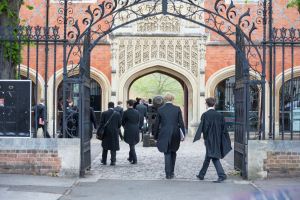 What were the particular challenges with bringing it into the 21st century? I’m particularly thinking of the very different social and societal set up that existed when they were written.
I always struggle a bit with writing stories in the present-day! My best stuff tends to be Victorian or Edwardian, I think, so this was a real challenge. It’s tough with James because the world that he depicts is often so cloistered and repressed. Time and again – as Michael Chabon argues in his marvellous essay, “The Other James” – the supernatural in these stories is a manifestation of repression. I tried to choose a setting in which that might still plausibly be true and a boys’ public school seemed to be a disturbingly good fit. I have to say, though, that the other three writers managed to update their stories more comprehensively and convincingly than I did in the end!
What was your process – did you work out the beats from the original and then allow imagination to flourish, or did you want to use as much of James’ structure as possible?
I re-read the story and put it aside, then wrote something that was my own interpretation. This left things quite a way from James. Subsequent drafts brought it back, closer and closer each time to the original. Hopefully it’s a fine mixture now of old and new.
 Did you find the original story limiting in any way, i.e. the fact that this was an adaptation rather than riffing off the same themes that James used meant it needed to be recognisable?
No, not limiting at all. I love the challenge of adaptation – though this was more in the field of transposition. I think it’s recognisable though, perhaps, I wish now that I might have made it just a little grittier.
 What was the biggest challenge overall of the project for you?
Trying not to feel that I was being presumptuous!
And finally, do you have another James story you’d like to tackle?
Yes, I’d love another stab at it! Number 13 would update very neatly – the haunted hotel room is such a satisfying and enduring trope. I’d love to do some in the original time period too… Back to my comfort zone of the nineteenth century!
 Doctor Who News Star Trek News
 Sci-Fi Bulletin: Exploring the Universes of SF, Fantasy, Horror and Spy-fi!