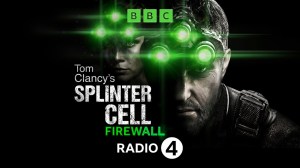
 Pilgrim creator Sebastian Baczkiewicz has two very different projects available via BBC Sounds at present – the Limelight adaptation of James Swallow’s novelTom Clancy’s Splinter Cell: Firewall, which he co-scripted with Paul Cornell, and The 5000, an examination of the aftermath of the Feeding of the Five Thousand. He chatted with Paul Simpson about the contrasting challenges involved…
The two projects of yours out at the moment couldn’t be more different. Is it coincidence of timing or just the way that things fall?
The way things fall really. I was invited to look at Splinter Cell while I was working on The 5000, and I was maybe two-thirds of the way through that when I started. There was a bit of a hiatus so I thought, ‘OK, I can do this while I’m waiting to finish The 5000.’ We started working on James Sparrow’s book and obviously Splinter Cell the book works very like the game, it’s a multi-stranded but linear adventure story. I think we were tasked to try to inject a little bit more back story and emotion for a radio audience.
The idea was to not just make the radio show of the game. We wanted to put more character into it – not that there wasn’t character in the book, it was just expanding what there already was.
I did have a go at the game, for research, but I didn’t know anything about it coming into it. I think my co-writer, the amazing Paul Cornell, did know it though. So the advantage of that, if there is an advantage, is that it’s a new story. When you start to adapt anything, you have to imagine – this is the first time anyone’s heard it, whether that’s Les Misérables, The Count of Monte Cristo or Splinter Cell. You’re writing and developing a story, an idea, for a listener who has never heard it before. Or at least, I always assume that. I was coming into it with no baggage.
 So in terms of practicalities, you alternated batches of episodes with Paul; you’ve got the beginning and he’s got the end.
Yes, we had a breakdown given to us, not of the scenes but just of the events [in the book]. It was a very quick conversation. I think that Paul was very keen to do the end.
There was one episode where I needed to keep Brody and his gang in the picture: there was a portion of the book where Brody and Samir disappear for a while – I think when they’re on the train going to Switzerland – and I felt that they needed to be kept the action. There was room for invention and, give credit, [Ubisoft] were all very generous in letting us do that.
Yes, it clearly is an expansion of the story in that sense.
Four hours is a lot of story time.
And the book is lean in that respect.
It is lean and I think that’s one of its great qualities.
Obviously you’ve adapted a lot of other material over the years; what were the specific challenges for this one, particularly given it’s very contemporary and tech heavy?
It is very tech heavy so maybe it was just a question of getting to the nub of things that were important to know. There’s a sequence where Grim goes through the assassinations of key figures and we had to be absolutely true to the book, but we had to lose some of the high tech stuff around it, because to a radio listener that’s probably not going to have the same magnetic appeal it does to readers who love that kind of stuff.
 Just diverting onto The 5000, where did that come from? It’s a fascinating take on Biblical events, because it’s a question about the events of the Gospels that doesn’t get thought of.
I went to a Catholic comprehensive in Brentford and I was every inch a Catholic until I was about sixteen and then rather abruptly my faith just disappeared – and almost immediately I started to study Religious Studies A Level. I had a brilliant teacher, Mrs Vickers, and suddenly everything that they didn’t teach us before then was taught such as] the context of these Gospels.
I grew up believing that the Feeding of the Five Thousand was pretty much a big picnic with Jesus up a mountain, everyone strumming guitars and such, while having a delicious miracle delivered. But it really struck me that it was in fact a politically huge event: you’ve got the uneasy detente that existed between the Roman Empire and this noisy little outpost at the corner of the world, for them, that nobody particularly wanted to be governor of or procurator of, coupled with all the swirling antagonisms which in some shape or form have continued forever in that region.
I’ve always wanted to examine through fiction what might have actually happened and the political fallout which might have been provoked. What would any government do with a sudden event where some strange chap turns up performing extraordinary miracles? And it seems, whatever stance one has on the figure of Jesus, that at that time strange unexplainable stuff was certainly happening.
Throw in the murder of John the Baptist, by the authorities who believed he was leading an insurrection – which John the Baptist possibly was; and you have the makings of an explosive drama. It also felt to be a very contemporary tale and I very much didn’t want to set it in distant ancient times. I considered it to be a bit like Romania pre-the fall of Communism – a client state of a much more powerful empire.
It’s about what the authorities do when confronted with the impossible.
It also seems, on a practical point, quite an unusual thing for the BBC to tackle in that respect. I could see it as part of an Easter series or at Christmas, but this was in the autumn…
Yes, yes absolutely. That’s a big up to Radio Drama really because they will take that kind of risk and they will say, ‘Well, that is interesting, nobody really has talked about it.’
I was extremely excited to work on it along with Splinter Cell too.
It’s the hinterland of the story that we know so well or we think we know.
Except, when that story was happening, it wasn’t hinterland. It was the right in front of you land (laughs). The Real Land.
It is actually putting the spotlight back where it would have been in 30AD as opposed to where it is now, where everything is Jesus-centric.
 Right and that’s fine, that’s how it should be, but there is a wealth of historical stuff out there if anyone’s interested in it to find out more – not least the academic commentaries on the Gospels themselves which are very informative. Of course Splinter Cell was brilliant to work on because it was completely the other end of the spectrum, as it were.
It’s fun to write all that crunchy, meaty dialogue, plus in Brody Teague James Sparrow gave us a gloriously unhinged villain, he is so crazy.
I wanted to give little idents to the characters, so I think the Sinatra-quoting Russian assassin [comes from] me! But it seemed to me that that was a good ident for a baddie. You’d always know that whenever Aslanov appeared, or if he was quoting Sinatra, something bad was going to happen. Although I suppose every time Aslanov does appear, something bad is going to happen!
Well yes, he’s not exactly going to be seen feeding the kittens..
No, no, indeed not. Although, that would be an interesting thing for him to have as a sideline…
It’s Blofeld and Bond. He’s stroking the white cat.
Exactly, you can’t get away from that. And nor should you. The genre is the genre.
There’s a language that is being spoken and is understood by audience and writer and actor.
Exactly. It really isn’t for everybody and you have to know it isn’t. You just make the work completely true to the form it’s from, in the same way that you’re not going to have Sense and Sensibility with Kalashnikovs and Uzis!
Splinter Cell: Firewall is available to listen on BBC Sounds here
The 5000 is available to listen to here




 Sci-Fi Bulletin: Exploring the Universes of SF, Fantasy, Horror and Spy-fi!