Sherlock Holmes Untold: Interview: Nicholas Briggs
A new series of Sherlock Holmes adventures is arriving from Big Finish starting this week, reuniting the team of Nicholas Briggs and Richard Earle as Holmes and Watson with scripts […]



A new series of Sherlock Holmes adventures is arriving from Big Finish starting this week, reuniting the team of Nicholas Briggs and Richard Earle as Holmes and Watson with scripts […]
 A new series of Sherlock Holmes adventures is arriving from Big Finish starting this week, reuniting the team of Nicholas Briggs and Richard Earle as Holmes and Watson with scripts by Jonathan Barnes and direction by Ken Bentley. But, as Paul Simpson discovered chatting with Briggs at the end of May 2025, there’s something rather different about these…
We’ve had a lot of sort of semi-interconnected stories through Holmes’s life over the last however long it is you’ve been doing them but this new series feels like something different. Why?
 We wanted to do something different. We wanted to structure it differently and – you’ve heard this a million times from people who make stuff – we wanted to make it a stepping on point and just give it a different feel.
So you can come to this not having heard any of our previous Holmes stuff, because Jonathan Barnes, who’s been writing our Holmes stories for years and years now, is brilliant and knows his Holmes inside out. He’s a proper Sherlockian.
He’s not bad on Frankenstein, either. I edited his Frankenstein book a few weeks back.
He’s smart. He knows about literature. He has connected a lot of our stories in the past and he’s always after the sequel, so he puts a little hook on the end. But for this, we decided we’d do something different.
 And the main thing we’re doing different, even though he’s got a linking story throughout these eight half hour episodes, is to look at all those cases that Conan Doyle / Watson mentioned that were never gone into. So we’re not doing the Sumatran Rat, but a load of other ones are in there. Each story is one of those cases that dedicated Sherlockians will have heard of.
We spoke to the Sherlock Holmes Society of London recently. We did an event with them at their AGM and luckily Jonathan was there because he’s the expert. When he mentioned some of the titles, there were ripples in the room.
We’re also giving it the kind of flavour of a sort of 1930s cinema serial, so the sound design and music is very of that era.
 It’s a bit – dare I say it, and I hardly dare say it – a bit [Basil] Rathbone in its flavour. Not in terms of the performance but certainly in terms of the presentation of it, very noir-ish.
We recorded it well over a year ago. We were just trying to find a release slot for it and that got delayed. The whole weekly release thing is quite taxing for our site to do. And as you might imagine, not that I particularly want to talk about it because we had that site falling over, the new site was planned to be able to do stuff like that really easily. That’s why it got delayed. I think it would have happened quite soon after the new site launched – August 2024 – so it’s almost a year later and it will be over a year later by the time it comes out in October.
 You and Richard Earle are back as Holmes and Watson. You have both played the parts so many times now, and Jonathan’s written for you. Do you feel that there is now a Briggs/Earle version of Holmes and Watson, or are you still very much going back to the Conan Doyle? Are there certain speech patterns that I associate with your Holmes that might not necessarily be quite Conan Doyle?
Yeah, it’s inevitable, isn’t it, whoever’s playing the part. It’s for others to say, I suppose, whether we’ve established our own particular spin on it.
I think the way Richard and I have done it has evolved. I think we’ve become slightly more comfortable with the way we’re doing it, because there’s a great deal of imposter syndrome playing Holmes and Watson, because it’s so massive and we’re just us, and Holmes is possibly the most popular fictional character in civilization. Everyone has heard of Sherlock Holmes; the character and the stories are popular in every country.
But I’m not sure how we differ from Conan Doyle’s voice. I think we strive all the time through Jonathan’s authenticity to get closer and closer to it.
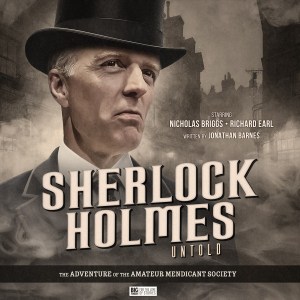 I suppose if I had to immodestly describe my own Holmes, I have a tendency, you won’t be surprised to hear, to go for the strong, obsessive, direct motivations in a character. That’s what the Daleks are like. I don’t want to draw any comparison between the Daleks and Sherlock Holmes, but Holmes is very direct and he is always on a mission and he’s such a quick thinker. In other performances they sometimes do a lot of considering and chin stroking, but for my mind, it’s better when Holmes is more direct and obsessively pursuing a goal. He’s always however many steps ahead of the normal human mind so he’s very direct and he ignores useless information almost immediately, which makes him appear to be tactless. I think it weakens him if he pauses too much.
It makes it a devil to play. I’ve set myself a really difficult task. Both when I’ve played it on stage and when I played him on audio, you really have to have done your homework. I remember once doing a stage performance and I was exhausted at the time. This was years ago, at the time Big Finish started Doctor Who in 1999: I was doing the post-production on The Sirens of Time at the same time as doing Sherlock Holmes in the evening. I remember at one point I just ran out of energy and just stopped because there was no energy coming.
 On audio, of course you can get away with falling over occasionally because they can edit it out. But I think it’s better if it doesn’t rely on editing and then I can deliver a perfect take.
Richard beats himself up a lot about all the narration [that Watson has], and he’s such a perfectionist about it. He’s always wanting to go back, and Ken Bentley, the director is saying, “honestly, you’ve got it”.
I love Richard. He’s such a lovely man. The night before we started recording these, we spent what felt like half the day, the whole evening on the phone just catching up.
You and I have talked on and off basically throughout the whole of Big Finish, going right back to pre- Oh No It Isn’t up to now, So that’s 27 odd years, which we’ve covered in DreamWatch then Total Sci-Fi and now SFB.
Wow.
 What do you think the biggest changes have been in the audio industry since you started working on the Benny audios?
I think the biggest change is that everyone else is doing it. And we didn’t notice because we were too busy.
Drama podcasts have exploded, haven’t they? I feel bored saying it because everyone says it. Apparently podcast advertising is the biggest growth area in advertising globally. Things only succeed when there’s money to be made. The podcast industry has increased because advertisers have realized they can make money out of it and really target it, because obviously television advertising has fallen through the floor because there aren’t those massive audiences anymore. But podcasts are huge and so many people have set themselves up as podcast distributors and they have their own advertising departments.
Podcast drama as well is really becoming a thing, especially in America where they don’t have the recent and ongoing tradition of radio drama. Of course, decades and decades ago they did do radio drama, but our radio drama has continued and in some perhaps slightly truncated form still continues to this day. So it’s very, very big and it’s particularly big in the genre fields, horror and science fiction, horror in particular – like the Magnus Archives, which is this massive horror franchise that is really quite a modest production, but they managed to crowdfund it for some eye-watering amount of money.
 The whole way of doing audio has changed and yet here we are carrying on doing it the way we did it in 1998. So I am making efforts to change us a little bit and change our approach to the way we distribute.
But that’s all for the future. Everything is still the same at the moment. Only 20% of our audience buy the CDs now and that figure is diminishing almost daily.
Is there a certain cause and effect of that from the fact that you’re only doing limited print runs? Or is it the limited print runs have come about because you only sold 1,500, so what’s the point in pressing 2,500?
I think we’re doing those because the sales tail off quite quickly. It’s not a good move business-wise to have lots of spare stock in a warehouse. It’s costly to keep. And it is a taxable asset of the company, which means you’re paying tax on something that you’re not making any money out of.
 Loads of costs for Big Finish have increased, all sorts of costs, and yet our listeners and customers don’t particularly want things to go up in price.
There’s been massive inflation and we have never matched the rate of inflation so we have to find ways to streamline stuff, and it’s certainly not an option paying our contributors less.
It’s not the limited editions that are driving the lower percentages of CD sales. It’s that is a reaction to the lower percentages of CD sales, and you know the big advantage (cue commercial) of our downloads is that they are download to own, and we’ve rebranded them as that because that’s what they are. It’s not like all these streaming services – I made the mistake of thinking, “oh, well, it’s brilliant that The Avengers will be on ITVX forever”. Then the other day I went to watch it and it was all gone.
You know, well, of course, if Big Finish disappears one day – it’s not likely to happen, possibly in my lifetime – if you haven’t downloaded your stuff yet, you won’t be able to get it again, so just download it and keep it somewhere. It’s yours. You’ve bought that, your copy of that production.
 I’ve also noticed, and it gets commented on every time that I run a news story about a new release, that a lot of new material is download only.
We’re trying to do that more and more, because that’s how most people buy it.
Of course, change is always a bit painful. A lot of people don’t ever listen to the CD. They just keep the CD, but they listen to the download because they get that as part of the CD purchase.
But there is a collector gene in an awful lot of Doctor Who fans.
Totally, yes, and we completely understand that. I don’t want to stick my neck out too much, but in some form or another, I think we will always maintain some form of physical release for some of our productions. We have looked into pressing on demand and stuff like that, but we feel that the quality hasn’t been good enough and I think it would increase the retail price as well, because I think the costs are much higher for doing pressing on demand.
We are marketing our CDs as collector’s editions now, because that’s what we feel they are. I would say this, but we don’t dictate what the market does. Benji Clifford, my dear friend and podcast co-host, said recently that there’s a feeling that the youngsters are leaving vinyl behind and now they’re getting keen on CDs. And I said “well, if that’s the case, we will adapt”.
 You’ve expanded again a lot of what I’ll call peripheral Doctor Who material, with Zygon Century and series like that. Is that part of insuring against old Father Time, bearing in mind the classic actors are aging?
No, we’re not doing things like that because we’re thinking about some of our Doctors no longer being with us. We’re doing those because we did a deal with the estate of Robert Banks Stewart. So we thought, “oh, well, we can do some Zygon stuff”. And, you know, they’re not on the BBC. So we just thought that it was something interesting to do.
A Zygon spin-off series is not going to do as well in terms of sales as a Doctor Who range. But we do have the Doctors. I think more and more we want Doctors turning up in our spin-offs because after all, they are Doctor Who spin-offs and we can investigate different ways of the Doctor being involved in the narrative.
What are you looking forward to hearing people’s reaction to in the coming months?
 The Thirteenth Doctor and the new Ninth Doctor and Rose stories, because I think they’re cracking. When the Fugitive Doctor and the 13th Doctor storylines came through, I just thought were really cracking. Same with the 9th Doctor actually, and these are our big beast releases.
We’ve got some new 11th Doctor coming up. Matt Smith hasn’t joined us, but I’ve just had the storylines through for that, and they’re really good.
Of course, personally, I’m looking forward to more from the Second and Third Doctor in particular. There’s a great one that Tim Treloar and I have written together for the Third Doctor, which I’m just getting the sound design for, and I’m just starting doing the composing for. The next box set of Second Doctor Adventures, we’re going into studio for in June. The First Doctor, that’s an epic adventure that I’d love to tell you something exciting about, but can’t…
 We’re kind of stacked up with the Doctor Adventures for the future. We’ve got a couple of scripts already in the bag that so there won’t be that awful last minute rush to get it into studio. Although ironically, the next one we’re getting into studio has been written after all the ones that come out before.
I’m waiting on Alan Barnes. He’s doing that thing where he sends me an episode every week. So it’s like I’m having a Flash Gordon adventure and getting an exciting episode every week! And then the next week he sends me the next episode and a rewrite of the previous ones. It’s really exciting. Again, I wish I could, I wish I could spoil it and tell you how exciting he is. I love Alan Barnes’s work, you know. He really understands storytelling.
I’m excited for, you know, really good people’s work coming out, like Rob Valentine as well, who wrote The Stuff of Legend, the live one for us, and a new young producer we’ve got on board, Alex Hewitt, who’s doing really good work. He’s an extremely talented young man, still at university.
 Doctor Who News Star Trek News
 Sci-Fi Bulletin: Exploring the Universes of SF, Fantasy, Horror and Spy-fi!