Review: Sherlock Holmes: The Seamstress of Peckham Rye (Big Finish)
1900. A new century, a new set of problems for Sherlock Holmes. But his Boswell is no longer living at 221B Baker Street… It’s not quite the gap that the […]



1900. A new century, a new set of problems for Sherlock Holmes. But his Boswell is no longer living at 221B Baker Street… It’s not quite the gap that the […]
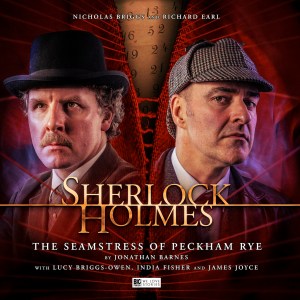 1900. A new century, a new set of problems for Sherlock Holmes. But his Boswell is no longer living at 221B Baker Street…
It’s not quite the gap that the original Holmes fans experienced between The Final Problem and The Hound of the Baskervilles, but it does feel an age since we last heard Nicholas Briggs and Richard Earl as Holmes and Watson. That was in what’s now clearly the first of a trilogy of tales with this new release tying off some of the threads from that story, expanding others, and introducing a proper threat to Holmes and Watson, as well as their associated friends and allies.
Jonathan Barnes once more gives us a more fleshed out Holmes and Watson than in many tales. Watson’s domestic issues and his relationship with Lucy Briggs-Owen’s Genevieve Dumont are front and centre in this piece, with Mark Elstob’s Joseph Drennan a thorn in their collective side – and it’s some time before all the pieces slot together. Holmes gains a new police ally in James Joyce’s Inspector Fisher with India Fisher’s Mrs Tyndall complicating matters, and Anjella Mackintosh’s couple of characters doing likewise. Rounding out the cast, Glen McCready plays a gamut of gentlemen, giving the impression of a much larger number of actors than was actually the case.
The central focus as ever is on Briggs and Earl, with the former following director Ken Bentley’s instructions to the letter in his performance of Holmes, particularly in the opening part. Earl’s Watson is put through the wringer, but at no time do you ever doubt that Watson will strive to do the right thing.
The play is a little more fluid than on some occasions – Benji Clifford’s sound design moves from scene to scene without a break at time, although it’s never unclear what’s happening, and there are moments when it feels as if Jamie Robertson’s score is playing with the mood rather than purely reflecting it.
Verdict: It may have been a long time coming, but this is well worth the wait. With some trepidation, given the foreboding and foreshadowing in the final part, I’m looking forward to the conclusion of this trilogy. 8/10
Paul Simpson
 Doctor Who News Star Trek News
 Sci-Fi Bulletin: Exploring the Universes of SF, Fantasy, Horror and Spy-fi!