Gorgon: Interview: Elf Lyons
Elf Lyons’ acclaimed stage play Gorgon is released on audio this week. Originally conceived as a live immersive horror, designed to prey on the senses, using live sound with expert […]



Elf Lyons’ acclaimed stage play Gorgon is released on audio this week. Originally conceived as a live immersive horror, designed to prey on the senses, using live sound with expert […]
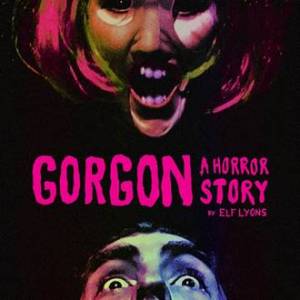 Elf Lyons’ acclaimed stage play Gorgon is released on audio this week. Originally conceived as a live immersive horror, designed to prey on the senses, using live sound with expert foley and horror tricks inspired by the gruesome Le Théâtre du Grand-Guignol’s famed Parisian naturalistic horror shows of the early 20th Century, Gorgon is now an all-embracing audio experience. Focusing on the still taboo subject of female anger, the show explores what happens when we are just pushed too far. Mild-mannered taxidermist Diana encounters one too many mean-spirited people, loses her temper and decides to experiment with the human form… Award-winning comedian and theatre maker Lyons chatted with Paul Simpson…
The PR describes Gorgon as a “lovely” audio. It’s not the adjective I’d have used.
 What would have been the adjective you’d use?
Terrifying? Horrific? Intriguing, if I was trying to get someone’s interest in it. But lovely? No.
I’m glad you found it horrifying.
It was. I’ve been doing this for a long time, I’ve seen and heard and read a lot, but secateurs through the urethra…?
Oh yes, I love that bit. I was in a short independent horror film a couple of years ago with Sam Ashurst called A Little More Flesh which is on Troma and I was really proud of coming up with the horrific thing that happens at the end of it. I won’t spoil it but I love the idea of sticking pins in penises. I think out of all the things, it gets such a visceral reaction, especially from male audience members and I feel like women, in giallo horror, we get so badly mutilated. I feel like men don’t really get the same level of mutilation.
I’ve had to listen to Gorgon so many times because I’m very particular. We normally did the sound live on stage but obviously it was just going to be impossible to try and do that whilst recording it. So Molly Isaac did all the sound foley separately and we just spent ages listening to things and saying, ‘This doesn’t quite sound like a head being caved in’ or ‘That’s the not quite the right effect we want for the throat slicing’.
The bit that I still can’t actually listen to is when I talk about spitting and spitting into each other’s mouths. That came out of improvising on stage. It started off as just a couple of lines and by the end when we finished the run, we had people leaving to be sick during that sequence. I’d really get into it and do it and people would leave. I feel like when you’re making horror, that is the best reaction.
Absolutely. OK, let’s step back a bit. Where did the concept come from for doing the Gorgon story?
 I love the Gorgons myth, I love Medusa. I’d made a show about Medusa at the Southampton Nuffield Theatre a few years ago and I’d always carried that love of that character and the myth about these women who were so ugly, they literally moved to the ends of the Earth. But the two sisters, Stheno and Euryale, moved to the ends of the Earth in order to protect Medusa because Medusa was mortal and Stheno and Euryale weren’t, they were immortal. Their job was to protect their sister because they knew Hera was constantly sending people to kill her.
I loved the fact that they are positioned as being monstrous but there is this sisterhood and this actual vulnerability there at the heart of that myth. That was something I knew I wanted to write about.
There were originally three sisters and they were originally going to be called Stheno, Euryale and Medusa, that was the names of the girls, but it just became a bit too on point.
The thing about myths and legends is they get re-translated. There are some versions where there’s only two Gorgons and in some there’s three so I thought I’d focus on the sisters. I’d take Medusa out of it and focus on the two that were always Gorgons.
The mother Luisa, I got the name because in my head she reminded me of Luisa Casati, the muse who posed a lot as Medusa for a lot of the surrealist artists. She’s meant to technically be Athena but that’s the stuff that inspires you to write but you don’t spend ages trying to link it, you just go with what the story is.
 And I also just love Texas Chain Saw Massacre.
The original? The proper….
Oh yes and Ed Gein was always really interesting. Everyone was really focusing on Fleabag when I was writing and this obsession about women opening up. In Fleabag she kills a guinea pig and I was thinking, ‘I want to write something where everyone gets killed.’
And they really do. You care about Diana – she’s got such a nasty boyfriend and she’s got such annoying flatmates. She’s just trying to run a business and she just loses her shit and basically does everything that you would never do – but part of you I think, kind of does want to . You do just want to get fucking angry. The whole bit about being angry isn’t really pretend, that’s just me talking about how angry you can be.
I like horror, I like comedy, and comedy and horror have a really beautiful duplicity and relationship. It seemed like a challenge and I like a challenge.
Let’s step back one step beyond that. What was the first horror that you experienced in terms of what you read or saw?
When I was little we were allowed to watch whatever horror films we wanted. We watched The Shining when I was about seven, we watched it really young, and my nanny used to let me go and rent anything I wanted from the Eltham Blockbuster so I rented every film that was there. I don’t know what it was but that just interested me.
I was obsessed with R.L. Stine because he was the only writer I could read – we weren’t allowed to read American books at my primary school. So R.L Stine was just a hero.
 I can’t imagine a primary school teacher being too happy if you walked in with Salem’s Lot!
Oh I love Stephen King. I’ve got a tattoo of the haiku from It on my arm.
It’s just a beautiful world, I just think horror is so brilliant. And I think it’s so healthy to love horror. All the kids that I teach love horror, they really engage with it and I think you’re really aware of when you’ve succeeded and when you’ve failed when you’ve created a live horror show.
What got you into wanting to do live shows? You know you’ve done it right or wrong, but it’s presumably quite risky to do it?
It’s so risky and that’s why I like it. I like taking risks.
I’m a very experienced live performer in comedy. I’ve won awards in comedy, I’m well respected for doing comedy shows. I like playing with high spectacle and I wanted to do something that was on my terms.
 It wasn’t something that my agent or anyone asked for me. It was ‘I love horror, I will self fund this. I want everyone to be paid properly, this isn’t going to be a profit share thing.’
So I saved up, I did a Crowdfunder, I did gigs in order to raise money or it and I got the best team. Which was actually also all female bar David [Hoskin], who I kill – that was just by chance really. But it was a really collaborative, challenging and exciting event.
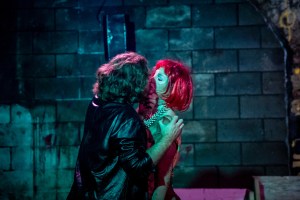
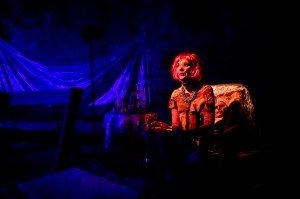
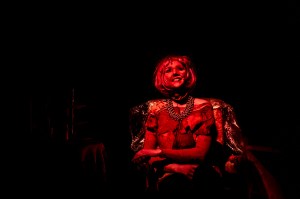
Molly who did all the sound design, she’s incredibly new. She’s very young, she’s 22. Incredibly professional and visceral and hungry. The set designer Sophia Pardon, when we did it live, made these amazing armchairs made out of skin and there were horrible mannequins. I wore an outfit that looked like it was made out of my dead mother’s body. The reveal at the end of the show is you suddenly realise that the thing that I’m wearing are these two large skinned tits with nipple tassels on. It was like a Mad Max / Texas Chain Saw Massacre mashup. I had this bright red/magenta wig on and tights all over my face with bits of skin so you couldn’t fully see my features, with drippy latex…
Why make a show unless you are trying to achieve something you’ve not done before? Or unless you’re trying to make a show that you haven’t seen yet. I don’t understand why you can’t have a female villain who is properly dark, who is evil in some respects but is also totally full of love and empathy. Why is there only Michael Myers? Why do the men get to be so gruesome?
One of the disorienting things about this is the fact that you jump scenes very rapidly. If it wasn’t for the fact I knew it was a single track that I was listening to [on the preview], it was almost as if I had pressed shuffle because the bits don’t always immediately feel like they should be together.
No, the timeline is purposefully mixed. I like it when you have to concentrate. I don’t want someone to listen to it at the same time as scrolling on Instagram because there are some things where if you blink, you’ll miss it.
How much did you re-think it for the audio and how much is the audio that we’d have heard on stage?
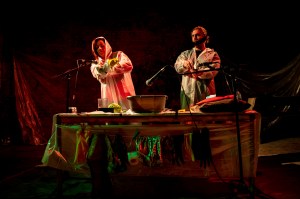
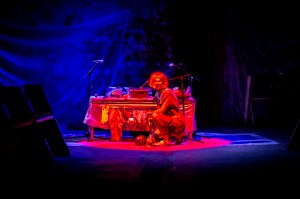 Almost all the sounds that you hear are pretty much what you would have heard in the play. When we did it live it was in the tunnels at The Vault under Waterloo, so you could hear trains coming over, and it was dripping, it was very wet.
Visually, there was so much you could look at throughout – there was a giant statue of a penis with a pair of scissors down the middle, it looked really realistic. There were things that your eye was constantly drawn to, which the audience listening don’t have so you have to be a little more didactic with the clues and descriptions. I had to make certain bits and pieces a little more obvious – but there are also some things that work better I think in the radio show than they do live.
I do think some things do work better for just your own imagination. For example, there’s a nightmare sequence in the radio play which we cut out of the live version because it didn’t work. When the audience know you’ve got a cast of three and you’re multi-role-ing and you’re doing as much as you can in this giant space, you have to be really clever with where the scares come from, because there’s only so many times you can just jump out of the darkness. So we used really effective lighting design – Lesley Talbot gave us such a beautiful giallo-inspired lighting design – and the scares had to be in some ways more sensual, more like the spitting sequence or the thing about the baby. They’re not jump scares, they build.
But the nightmare sequence, where I would stand there and describe this dream and this creature, just didn’t work for some reason. It didn’t take you to where you needed to go.
You’ve already asked them to suspend disbelief and then you’re asking them to suspend disbelief within that disbelief, whereas with audio, you’re already in an unnatural environment as opposed to suspending your disbelief.
 I think it’s more resonant when you’re listening to her describe it because we’ve all had those nightmares but you’re on your own and you can’t control how far your brain’s going to go imagining that. The fact that you’re home alone listening to it, most of the job has been done. It works because you can’t see her. You don’t have eye contact with Diana. She’s describing these things in your ear, you’re already getting a very jumbled narrative. You’re uncertain how much of this is actually real and how much is fabrication, so there is this sense of picking and choosing what you decide is the actual truth. What is actually in the basement? Was the mother really as bad as she is? Was it just a child’s memory of an evil stepmother?
On stage, did you have contact lenses for the yellow eyes?
No, I can’t wear contact lenses. Because of what I was wearing and where the audience were seated and the way the lighting was, we did consider it, but the audience couldn’t see it. I’ll do anything for a role. I’ve been hospitalised for performing so I’ll go hard but also, cost wise, do you spend £20 on contact lenses the audience can’t see?
You took it to audio, would you want to take it a step further and take it to film?
Definitely but I already started writing it as a series because then I could take more time with it. I came up with the timeframe and re-clarified it. I would like to do it focused from each different character’s point of view.
 I think it would actually work beautifully, as a film. I love giallo films where you always see the leather hands, you always hear the heavy breathing of the murderer and you never see their face but it’s all very sensual and tactile. It’s always through glass or mirrors and I really like that. So if I was going to make it as a horror film, it would have to be in that style.
Gorgon is available now on Bandcamp to purchase here
 Doctor Who News Star Trek News
 Sci-Fi Bulletin: Exploring the Universes of SF, Fantasy, Horror and Spy-fi!