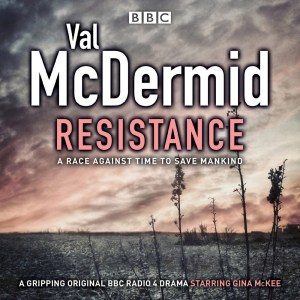
 The most recent Dangerous Visions play, Resistance, was penned by Val McDermid following discussions with Professor Christopher Dowson of the Infectious Disease Research Group at Warwick University. Professor Dowson, who is also an Antibiotic Research UK ambassador, chatted with Paul Simpson about the wider-reaching implications of the drama – and how far less of Resistance was fictional than one might want to believe..
How did you get involved with this dramatization?
I think this is really down to the Wellcome Trust who do an absolutely fantastic job in trying to engage the scientists that they fund for biomedical research and the public in all sorts of different ways, whether it’s in art or various media.
In February last year, the Trust pulled together about ten writers, a similar number of producers and a similar number of scientists at their headquarters at the Euston Road, London. Dame Sally Davies gave an overarching perspective as to what the problem was and then the scientists there, including myself, who have their own particular perspective and their own aspect of research, just got paired up, and I happened to get paired up with Val [McDermid] and Sue Roberts.
I think it took just half an hour for Val to get it, and then she left me with Sue Roberts, for the two of us to agree how to get the facts together and feed them to Val. We had a few iterations of telephone and email conversations batting back and forwards, and came up with the idea which we then pitched to the Radio 4 Commissioning Editor. That was about it. It was quite exciting, and different from my day job.
 So were you giving Val and Sue a timeline of the worst case scenario?
If we’re talking about Resistance, the timeline’s about the most fictitious [element] if you like. I’m surprised I’ve not had a whole load of epidemiology colleagues [commenting]. The epidemiological side, and the final number left, is where the fiction is.
For me the important part was to engage the public, make them aware of some of the key drivers and problems that have got us to where we are with antibiotic resistance – the use and consumption of antibiotics in humans and animals – and make them aware that bacteria mutate to become resistant.
It’s not the people becoming resistant to the antibiotics, but the bacteria: over the last two years, 50% of all news reporters (not Joe Public) have misunderstood that. They still think that it’s an individual who becomes resistant and if they’ve not had antibiotics, they’ll be okay.
That’s a really, really, really crucial fact because [if you think that] you go, “Ok there isn’t a problem, because there isn’t a problem with me – I’ve not had the antibiotics therefore when I get the bacteria, it won’t be a problem for me.”
This is a global problem: there’s misuse somewhere in the world and those bugs will come and bite somebody else.
And you don’t need to be in immediate contact with those people.
Exactly. It’s this global village scenario, where we need social corporate responsibility everywhere.
 So something happening in Outer Mongolia could affect us in Warwick or Brighton…
This is where you need to delete the “could”. It does, it is happening now. In India for example – I think there’s well-recorded statistics that perhaps half the people who travel to India as tourists come back with multi-drug-resistant bacteria in their gut.
That’s purely from living in the country?
Yes, and then you transfer those back on high speed express, smuggle them through Customs, go through the “nothing to declare” when actually you’ve got plenty to declare. That global shuffling is a reality now.
Series like the original Survivors back in the mid-1970s, which worked from the same sort of idea, were derided by the public as pure fiction. How long have scientists been aware that this is a problem that’s growing?
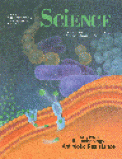
In the scientific literature, it was the mid-1990s, Science magazine, Nature magazine – there was a good Science cover in the mid-90s: “End of the World Apocalypse, Drug Resistant Bacteria – What are we going to do?” It’s taken twenty years to get out.
 What practical things can people do?
Cancer Research gets something like £500 million a year; I can’t remember what proportion of that comes from philanthropy from the public – a huge proportion. I’ve written to Cancer Research UK saying, “Can we have 10 percent of your budget, nothing really, to contribute towards antibiotic discovery because a very large proportion of your therapies wholly rely on effective antibiotics?” Kids who’ve got leukaemia, or anyone who’s become neutropenic – they’ve lost their white blood cells – the only thing that keeps them alive is antibiotics. The same if you’ve had major surgery to remove a tumour. If you haven’t got the antibiotics, it doesn’t matter how good your cancer therapy is.
I honestly think if we can make the public aware, then they might think, “I need to give to antibiotic research”, because clearly the industry isn’t doing it.
That was the other part of the story we tried to get out – there’s no money in this any more. At present value, on economic terms, discovering an antibiotic is about minus 25 million – so who’s going to sign off to say “Let’s just blow 25 million, even if we’re successful?”
For me, the deal is to win the hearts and minds of society globally – and it has to be global. The public need to understand all the complexities. It goes beyond just “I need new drugs to make me better” it’s “I don’t ask for them when I don’t need them”, “I put pressure on governments because I don’t want antibiotic residues in my food”, “I don’t want people filling my pigs and chickens with antibiotics” because somewhere down the line, somewhere in the world, we’ll pay for that with drug-resistant bacteria that are going to come out of those animals.
 I want to put pressure on hospitals to deal with the waste that comes out of them – so much antibiotic gets flushed down the toilet, effectively, at hospitals, straight into the waste treatment plants. Same with the pharma companies that make antibiotics – their waste streams are riddled with antibiotics and go straight into the environment. We’re filling the environment with antibiotics and we’re degrading the very thing we should be preserving.
And if it means wrapping it around a slightly apocalyptic scenario in a microbiological scenario that is a bit tricky to happen…
Although saying that, the Black Death, the plague, evolved in a way that [the fictional] ZIPS did. It was an organism that sat around causing a bit of a problem, sat in your gut, which then fused, genetically mutated by acquiring genetic material from other organisms. Then it became Yersinia pestis, the Black Death and wiped out a quarter of Europe. That’s something that happened quite recently, in evolutionary terms – there’s a window of between two and ten thousand years when the Black Death arose: it’s quite a new organism.
That was in the back of my mind: what if something like that happened – it’s a whole new game changer because you’ve got an organism that’s got such a huge host range. It can transmit through the air via birds, it can go by waste, go via sea… We’re guessing as to what might happen with something that’s never happened before.
 Are you able to say what the trigger might be? Or is it a case of “it will happen, we just don’t know when”?
If you go to mainstream science, or Google “What are the 10 plagues that are going to wipe the planet out?”, almost everyone says it’s going to be a zoonotic infection, something that’s jumped out of animals. As to exactly what that is going to be, everyone normally goes for a virus, because influenza is such a good example, when you get influenza from humans fusing with avian variants. I have a great picture on my wall of a Thai chicken farmer spitting into a chicken – it’s a traditional way of keeping them quiet – and you’re instantly transmitting your influenza virus as a human from your mouth into the chicken’s mouth or vice versa.
The proximity of life, and the increased expansion of white meat production – chicken and pork – is astronomical, particularly in Asia. The population expansion in Asia is phenomenal: I recently went to China and went through their subways and Tube stations and thought, “what a fantastic place for a disease to spread”. We’ve got these megacities arriving, and uncontrolled antibiotic use.
 It sounds like it’s not just a cultural shift that’s required but almost a tectonic plate level cultural shift that’s needed to change it…
It is. The more people that there are, the more animals that there are, the more disease there will be, and there will be increasing pressures. All of this will start to ramp up – it’s not like we’re at the pinnacle of the problem. We are going to have to put into place generational programs of change in behaviour, in research and development, and practice that we’ve not had before. We’re going to have to go at this in new ways.
Before antibiotics we used to have fever hospitals: if you had an infectious disease, you were not kept in the same ward, you were taken out and put into a separate building. But with antibiotics, you can put them together – but we can’t do that now. Control of infection is a real problem…
The reality sounds more apocalyptic than the dramatic version!
The facts that drove that drama are actually reality now.
 Would you like to work on a further drama?
Yes – antibiotic resistance is so multifaceted. You have to come at it in so many ways – medical, veterinary, industrial, government, public…
I can see many strands of the complex warp and weft within this fabric that is Resistance being unpicked. You can then talk about hospitals, what happens in the agricultural industry, what happens when government makes decisions? For me there’s a whole range of follow-ons that could be possible, but you need someone an awful lot more dramatic than I am to make it as engaging as Resistance, which is why I think the partnership between arts and social sciences is so important to help communicate ideas and change.
All three parts of Resistance are currently available on iPlayer:
Part 1
Part 2
Part 3
Thanks to Ruby Haider-Smith for her help in arranging this interview and Antibiotic Research UK for the picture of Professor Dowson, Gina McKee and Val McDermid




 Sci-Fi Bulletin: Exploring the Universes of SF, Fantasy, Horror and Spy-fi!