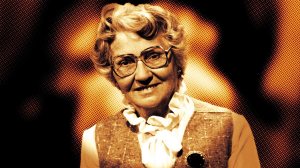
 Last month marked the anniversary of the trial of The Romans in Britain, focusing attention once again on Mary Whitehouse. Accompanying their documentary about the court case Disgusted, Mary Whitehouse for Archive on Four, Samira Ahmed and Simon Guerrier chatted with Paul Simpson.
How much did either of you know about Mary Whitehouse prior to actually digging in on the research on this?
Samira: Well, this story comes from me because I bumped into the head of the Bodleian Libraries at a reception at the German Embassy in summer 2019 who said, ‘We’ve just acquired Mary Whitehouse diaries.’ A light went on in my head. I grew up in the seventies and eighties and I always had this idea of the woman as this anti sex harridan. I wondered what her diaries were [like]… I knew that she was very big on anti porn, and I wondered if that had actually held up better than you might think.
 By interesting coincidence I’m almost the same age as she had been when she started her Clean Up TV campaign. She was 53 and I’m 53 now. I thought, ‘I want the whole story.’ I think too often we find out that women were painted a certain way and actually the fuller picture is different.
So I straightaway got in touch; I actually went to see the diaries before they’d been archived, when they’d just got them in the building. I met Fiona Whitehouse, her granddaughter who worked at Oxford University and was instrumental in getting them there. I said, ‘I think there’s a book here. I would really like to spend time with her and I think I would do a good job.’ So although anyone can access them through the appropriate channels, I think they were very happy that I wanted to research her with an open mind.
The following autumn, autumn 2020 during lockdown, I would drive, sometimes three times a week, to Oxford and spend the whole day from 9am to 7pm in the library. I went through the cuttings in chronological order from 1968 or 1969, which are the first diaries you’re allowed to see. (Some of them are closed because of references to living people.) There’s the diary itself and then there’s a box of the cuttings: newspaper cuttings, letters, drafts of letters and notes. I would go through them all, year by year and I made notes and took photographs and I planned a book which I still have in mind. I [also] thought, let’s get a documentary out there.
Simon and Thomas Guerrier, we’ve done a lot of really interesting takes on figures together, and they’ve often had a female focus, even John Ruskin’s Eurythmic Girls which was reassessing John Ruskin, not as a woman hater but as an accidental feminist.
I pitched the documentary in January to Radio 4 direct and said, ‘I really think there’s a story here about reassessing her.’ And they said yes straightaway.
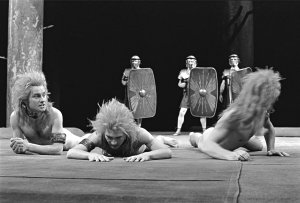
We found a peg in March. There’s lots of anniversaries but March is the 40th anniversary of the collapse of The Romans in Britain prosecution and I think that story’s emblematic, that case is horrifying. What was she doing suing a director of a play? And yet it’s useful to understand the bigger picture from her point of view.
I don’t think we excuse anything but I also think I place her in a bigger context which is her war on obscenity which is about protecting children and about not normalising [behaviour]. Basically she was saying, ‘You are staging a rape in the centre of the stage and that’s like watching a rapey porn film.’ You can argue she was wrong but that’s how she saw it: that was the National Theatre and it was the same as if the BBC showed it. It would be normalised, saying this is entertainment.
I basically handed over my brain seething with ideas to Simon then he found all the archive and came up with this beautiful structure. Fiona I brought in as an interviewee and the librarians at the Bodleian were very willing and keen to participate to show they had modern collections; Sam West who directed the only professional production since; Nicholas de Jongh I traced through Michael Billington and he was a living witness and knew Mary, he crops up in her diaries a lot; and Michael Billington, he was a critic who was there on the first night.
Did this change what you thought of Mary Whitehouse? What did you think of her beforehand?
 Simon: I grew up with Mary Whitehouse as a sort of figure of fun on things like Spitting Image and because I like Doctor Who, I knew of her criticisms of Doctor Who. So, I remember vividly her, in a documentary from 1993 talking about Doctor Who where she’s still haunted by a particular cliffhanger from nearly 20 years before [The Deadly Assassin Part 2] ‘I still see it in my mind’s eye,’ she said. And I have to admit that for all that story is very exciting and very engaging, it was shown at half past five. That seems extraordinary to me now.
In 2003 my friend Jonathan Morris wrote a piece for Doctor Who Magazine talking about Mary Whitehouse’s responses to Doctor Who and daring to suggest something that many Doctor Who fans didn’t really want to hear: that maybe she had a point about some of this stuff. That maybe she shouldn’t just be dismissed. I love Doctor Who, but there’s bits of it I’d be wary about showing to my own children until they’re a bit older.
I had that at the back of my mind when Samira was telling me what she was working on and I thought it was interesting to dig into what motivated Mary Whitehouse, and how she operated, and the effect of her various campaigns. Then, as far as I was concerned, the idea of doing a documentary came a bit out of the blue and was very exciting but we had to deliver this in six weeks.
So I was led by Samira and her research. She’d obviously spent months going through everything so my input into the documentary was to say, ‘We need to get as much of Mary Whitehouse’s own voice in this as possible.’ There are two ways to do that. One is that we’ve got the diaries, so how are we going to get the diaries into the documentary? I suggested we have somebody read as Mary Whitehouse. And the other thing was that we should get archive of Mary Whitehouse speaking for herself. What came out of that was this idea of dovetailing what the archive says with what Mary Whitehouse made of what was going on, because sometimes what’s happening on screen or on radio is not what she thought or felt.
Samira: The decision to drop the prosecution, in the diary she said: ‘Oh I immediately thought, I don’t want to cause any more agony.’ But in the interview that we run she says, ‘Oh, it’s the prosecution’s decision… it’s the lawyer’s decision and not mine.’
Simon: There’s a bit on Newsnight on the day that the case is withdrawn – it doesn’t collapse it’s withdrawn which is technically a different thing. The narrative in all of the coverage is that it’s collapsed and she finds herself on the back foot basically and then is attempting to regain ground in all of the news…
Samira: I think it’s fair to say there was an anxiety, which is in the diaries about, if they’re going to have to pursue the private prosecution themselves, there’s a cost issue if they lose. I think there was a genuine anxiety probably from [barrister Ian] Kennedy that no jury was going to convict.
Simon: She says on Newsnight, ‘There’s all of these people talking about costs but that’s never been raised.’ It was raised.
Samira: Yes, it’s in the diaries.
Simon: But she says ‘I’m not going to have to pay any money out of it.’ And then…
God will provide.
Simon: That’s exactly what she said and she’s doing interviews saying that.
The thought that God will provide would be almost a given, for her.
 Samira: But I think it’s really important that there’s two very different aspects to Mary Whitehouse. There is that whole evangelical, prayer-led side which is obviously very central to how she thought but practically, if you look at how she argued in public, including through the letter pages of newspapers, which was a really important forum then, it’s pure logic and argument about pornography and its pernicious effect. She’s citing research from the States. That’s the stuff that I was interested in, dare I say, as a feminist.
I’m not in any way trying to excuse the kind of questionable Christian beliefs and if you look at the persecution of something like Jerry Springer the Opera, which was written by a friend of mine, Stewart Lee, I shudder when I think of the grief they went through.
I’m really conscious that there are many people who will think any attempt to say ‘Mary Whitehouse had some interesting and progressive ideas on this issue’ cannot be separated off from the torment she caused to so many people. I kind of understand that and it is in the programme: we could spend half the programme talking about persecution and the horror of what it was like to be gay in the eighties.
It’s one of the great mistakes she made. Because she went on and on about the Christian evangelical stuff, she alienated people who might have formed alliances with her and I’m a great believer in strategic alliances.
I’ve written a piece for the BBC News website: if you look at the 2021 Domestic Abuse Act, it has put non-fatal strangulation in as a specified offence. That’s a very Mary Whitehouse approach. She got mocked for making a list of prescribed acts for a proposed obscenity bill – The Laundry List it was called – saying these acts are obscene so if they’re portrayed anywhere…and of course it was too simplistic but non fatal strangulation in porn, we know, it seems anecdotally to be very much linked to the rise in women experiencing choking. If Mary was around today she would be saying this and in her day when she was saying the equivalent she was mocked and told, ‘No it’s not true, it’s simply free speech versus censorship.’ And we know for a fact now that’s not that simple. So I’m interested in where she was using logic and evidence.
In her drafts can you see her pulling her arguments together?
Samira: No, no, they’re very polished.
Sometimes, in her diaries or in a newspaper you’d see her making notes, a couple of keywords, but I think she thought at an incredible level. I have done a lot of interviews for my proposed book that aren’t in the documentary. I’ve interviewed John Major, I’ve interviewed David Mellor who was Home Office Minister who worked with her on the obscene videos thing, the so called video nasties, and an interesting interview with Graeme Garden about the episode of The Goodies [that portrays her]. It’s really interesting how Mellor and Major both have stuff that they really disagree with her on but they think she was right on obscenity.
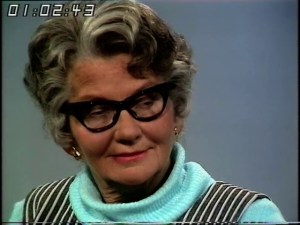 Graeme Garden actually directed me to one of the YouTube videos of her arguing with Jill Tweedie on a discussion programme and said ‘Oh my God, look at her arguments.’ And basically like a lot of people in the seventies – including Tom Baker when I saw him speak at a screening of The Talons of Weng-Chiang – they were all admitting that actually Mary Whitehouse in certain points was right and that if you listen to her argue, I know that she could be stubborn and wrong headed but she could also be really strong. Too many posh middle class interviewers were talking over her and trying to dismiss her and not listening to her.
Simon: I watched and listened to an awful lot of archives of Mary Whitehouse and I can’t say that I warmed to her. It wasn’t just that I objected to many of her views, but also how she went about things. There’s a lot of interviews where she talks over people. The sense I got was that she puts her point of view and if you still don’t agree with her, she can’t understand it, and she just gets exasperated.
What happens in an interview, time and again, is it will be her and somebody else. They’ll talk to Mary Whitehouse, they’ll then turn to the other guest, the other guest will start talking and Mary Whitehouse will talk over them.
There’s a David Frost interview from 1974 where it’s her and Hermine Whitfield, a Black woman who’s working on the front line of sex education in London and dealing with all sorts of problems and it’s Mary Whitehouse talking over a Black woman every time she opens her mouth. It just plays really oddly, and I found it very uncomfortable to watch. We couldn’t use that in the documentary because the shock effect of that is happening visually and you couldn’t explain that on radio very well but it’s a really striking moment. But I don’t think that was necessarily because there was any sort of racial element in her behaviour.
She does the same thing on Newsnight on the day that the case is withdrawn where they interview her and then they cut to Joan Bakewell interviewing Sir Peter Hall who’s the director of the National Theatre and Mary Whitehouse can’t bear to listen to him.
Samira: I bet that was Peter Hall saying, ‘I won’t be interviewed with that woman.’ Because why weren’t they interviewed together? I know too well after thirty years of broadcasting that women are usually talked over, so in a way I kind of feel she was giving one for the team. Why weren’t they in a discussion together?
But somebody of that generation and that set of beliefs, their way was the only way. There wasn’t an argument with it. You cannot argue with someone who is right and that’s how she took it.
Samira: She would say, ‘Listen to me, all I ask is that you listen to me. And if you don’t agree with me then you’re wrong.’ Which is frustrating but she did go to student debates and could have just not done them. But she used to go. All these years she was debating with the head of Playboy clubs and pornographers and you have to respect the fact that she would go into those arenas. I think those moments when she’s really wrong she goes very quiet and she just pretends it never happens.
 There’s a great one that I found which wasn’t relevant to this but she had a big war on EastEnders. She was right about the Angie attempted suicide: suicide attempts went up in London and was documented in a letter to The Lancet because it showed explicitly how to do it. And we don’t do this anymore. If you look at all the things that television no longer shows that she was complaining about, you cannot pretend that she did not have a very significant influence. No one is saying we should be showing people attempting suicide and how to do it, are they? So you have to thank Mary Whitehouse for saying that.
At the time she was accused of trying to censor things but she got a letter from the Bishop of Stepney because she was complaining of the portrayal of a single mother who had started working as a stripper to make money. She complained vociferously that ‘this show is degrading and it’s showing disgusting degrading behaviour’ and she got this amazing handwritten letter from the Bishop of Stepney which I found in her private papers, saying “You are so wrong, these people have incredible dignity. This show celebrates the community, the resilience in the face of poverty. I work and live among East Enders in Stepney and I can tell you, you are completely wrong.” And she didn’t write a word about it in her diary and as far as I’m aware there’s no reply to it. She wouldn’t have replied because she would have been lost for words. That’s one of those moments where I think, ‘Mary, you were so wrong and you were completely owned.’ I would have been happy to put that in the doc if there was a place for it but there wasn’t.
I don’t want anyone to think that I’m Mary’s biggest fan.
In the documentary you have opened out a lot of different areas of her, using a focus on The Romans in Britain trial. You’ve used that as a mirror into different bits of it.
Samira: Which Simon drew up beautifully. Simon found all that archive and made that connection. He came up with a really good structure and then I threaded through the points. For example, I drew up the big point about why she went after The Romans in Britain was, this brings Soho porn onto the National stage, so that’s how it connects to her mission against obscenity. I had the bigger picture as to why I thought there was a positive story behind it. We talk about the play: what does the play show? It’s an artistic discussion about the artistic merits of this and the staging of it, it’s not just about the court case. So I’m really proud of it as a piece of art.
Simon: Just picking up on what Samira was saying about people’s responses, I think what’s really telling is Mary Whitehouse would use evidence in her arguments. She uses the law, she’d quote Hansard, she’d quote from academic studies. In her objections she’d quote from The Lancet but an awful lot of the time, what she’s quoting from is not the original texts, she’s quoting from what the newspapers have said. With The Romans in Britain, she didn’t go and see it. She was responding to newspaper reviews having been rung up by the Press Association for a comment. And I thought, ‘Well, Twitter can be a bit like that…’
 Samira: It doesn’t change the fact that the national papers were stirring this up. Michael Billington says it in the programme and Michael Grade has told me as well: when there were a lot of attacks on EastEnders and on Channel 4, that’s when the Murdoch press in particular realised that there was huge mileage in just constantly attacking the BBC through Mary Whitehouse’s campaigns. It sold copies: “pornographer in chief”, all this stuff was selling newspapers. I’m glad we got a mention of the role of newspapers, of the popular press feeding this frenzy of moral panic which of course exists today. You’ve got Oliver Dowden going on about ‘woke’ stuff in that speech at the Heritage Foundation, it’s all been there since the seventies.
Inevitably I think, would Mary Whitehouse have liked me? Would I have liked her? I think from her papers, I could tell if you crossed her it would be terrifying, however I think I might have quite enjoyed her company. I think it’s very telling that Germaine Greer and her I think recognised a kindred spirit.
Simon: There’s a bit in there where Germaine Greer asks Mary Whitehouse if she gives her breasts to her husband as succour – there’s a line in the Bible about that – and Mary Whitehouse basically goes, ‘Well, you know to be honest, it’s none of your business,’ and gets a huge laugh from the audience. And then the interview ends with Germaine Greer giving the statistics for the sales of vibrators in the UK because, is using a vibrator adultery against your husband? And Mary Whitehouse is going, ‘I really don’t have an answer to that.’ But she’s not flummoxed, she just says, ‘I don’t really have an opinion on it.’
Samira: That’s the other thing: you hear from these diary extracts that Mary talks about ‘anal rape’. She’s using the language. She uses the term ‘buggery’ and all these things, there’s a really practical mind. She’s a school teacher, she taught sex education.
Simon: I think the mistake made by many people who took her on is that thought she was a prude and that her campaigns were based on her being embarrassed by all this stuff. She was not embarrassed by it.
Samira: She’s not embarrassed by it, she’s unembarrassable, that’s the biggest thing about Mary Whitehouse that people get wrong.
She was a first generation of the liberated girls. She was eighteen when women over thirty first got the vote, so everything was new. She was the first generation to have that and she went from that, women only just getting the vote, to sitting on television and talking over the men… and they were all men, who ran everything. They ran television, they ran the theatre, and they were London based, most of them. And they thought, How dare this older dowdy woman tell us that we’re wrong? It’s amazing to think that she was able to do that then when even now, how many women over fifty do you really see getting air time?
What’s interesting is she never did get onto the boards of anything, so I sometimes wondered what would have happened if she had been put into the board of something like the Broadcasting Standards Council. That was set up at her instigation. She kept saying ‘The public should be involved in helping set the standards because we’re the ones who it’s for and we’re the ones who are paying for it.’
 So, actually the model we’ve ended up with – Ofcom – is arguably quite a good one. They do do a lot of audience research and you don’t have people like Mary Whitehouse wielding incredible power but it’s funny that she would have wielded incredible power if she could have.
I asked Michael Grade, ‘Do you think if you’d actually co-opted her in some way, like if she’d been on the BBC Board of Governors, would that have perhaps slightly diffused her constant ire?’ And he went ‘Oh God no. There’s nothing worse than offering previews to members of the public anyway and asking their opinion. You’ve got to trust your instincts.’ And I think he’s right on the whole… However I would say, as someone who’s spent thirty years working in television and who presents a programme that is about complaints about news coverage and television, I do think there is an arrogance still – and I’m not talking about Michael Grade, I’m talking more generally in the way television is made. You hear it all the time: ‘We know best.’ Just because you’ve been doing it all along, it doesn’t mean that you’ve got it right… or unconscious biases all those things, and Mary to some extent was challenging that.
Archive on Four: Disgusted, Mary Whitehouse is available now




 Sci-Fi Bulletin: Exploring the Universes of SF, Fantasy, Horror and Spy-fi!