Harland: Interview: Lucy Catherine (Series 2/2022)
The second series of Lucy Catherine’s Harland aired in the Limelight strand a few weeks ago, and as part of our end of year celebration of genre audio, Paul Simpson […]



The second series of Lucy Catherine’s Harland aired in the Limelight strand a few weeks ago, and as part of our end of year celebration of genre audio, Paul Simpson […]
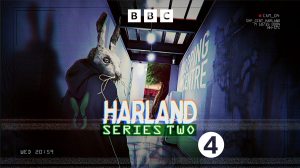 The second series of Lucy Catherine’s Harland aired in the Limelight strand a few weeks ago, and as part of our end of year celebration of genre audio, Paul Simpson chatted with her about the changes for the series this year – and the future (and past) of Harland…
There’s a new narrator – Tyger Drew-Honey’s Dan – for series 2. Was that always where the story was going to go and therefore the narrator needed to move to Dan?
Yes, it was always going to go that way and I always knew I was going to shift the narrator to Dan.
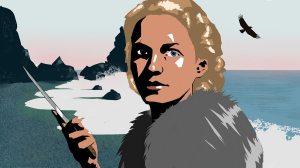 I don’t know if you heard that the seven part series I did, Gudrun, the Icelandic Norse, but that was the same narrator and the same central character all the way through all seven series, which was brilliant because you really were invested in them but I just wanted to give myself a bit more freedom on this one.
What’s lovely about when you change your narrator to a different actor, and someone who’s completely different like Tyger is, is that the whole tone of the show just changes and I think that has happened. That internal voice really does set the tone. So I thought, yes, just change it up and keep the audience, the listeners, on their toes and not just give them more of the same.
Were there any things that when you came to writing his voice that you wish you’d set up in series 1? Or was there anything that became a cul-de-sac because of something either in the writing or in the way that it was played?
I think his character was quite clear in series 1, his voice was quite clear, so I didn’t really have a problem with that. I sort of felt like because he didn’t have much of a backstory in series 1, it gave me a lot of freedom to take him somewhere and give him a bit more depth, which he didn’t have that much of in series 1.
 I think I was more just excited by the challenge really. And I know Tyger as an actor because he was in another series of mine quite a few years ago now called Halfway Here where he was also in every scene. He can do funny and vulnerable and moving – he’s just very very versatile – so I knew he’d be able to carry it.
The tone changes within this series as well. By episode 4 we’re into more horror territory and then a multiverse side in episode 5…
Yes, I have packed a lot into this series, it’s plot heavy.
When we spoke last year, you mentioned that you’ve moved some stuff out of series 1 into series 2. What stuff have we now heard that got moved that might have appeared in series one?
Fordingbridge was originally going to be in series 1 and he got shifted. I think he was mentioned, or the Fordingbridge Institute, but he was going to arrive in series 1. I decided to defer that, and then he’ll have a much bigger role moving forward.
Have you worked through roughly where the whole thing is going or do you simply know what parts of the story have got to be revealed to explain the present? Or to explain things that are happening to Dan and Sarah?
I’ve got an arc for the whole thing, yes. There is a whole story in the third series, which isn’t just about explaining what’s has happened so far – it does do that but it’s a story in itself and it’s quite separate in some ways. It’s not just a continuation, the whole thing’s been worked out. And it is the final series, which is nice to know, because you don’t always know that, which is always tricky! But I do know it’s the last one, which is really good. So I can have a proper ending.
 Last time, we were talking about the challenges of writing the first series, not knowing if you were going to go ahead with the second.
Yes and that was an issue actually, we didn’t know with series 1. I hoped so and I did write it as if there was going to be a series 2. In the end, there’s not much you can do about it really. You’ve just got to hope the listeners understand.
This one has far more of a cliffhanger. Basically, the world is going to shit and Dan seems to be our best hope…
The whole subtext really – definitely of this series and there was a bit of it in series 1 – is the whole climate change / climate catastrophe / emergency that we’re in. I wanted to find a way to write about that that wasn’t too on the nose. I wanted to write about how, when everything looks like it’s certainly going to shit, if you’ve got a bit of hope, it keeps you going. You can’t destroy hope. If you’re still alive, it’s still there, there’s not much you can do about it!
The end of episode 3 where Dan talks about the hope’s in the heart, the heart’s still living, that felt almost like the theme of the series.
Yes, I think it is the wonderful thing about human beings, actually, is that we don’t give up, regardless.
And I think, those of us who are parents, you can’t because you want things to be better for the next generation
Yes, yes.
No, I’ll rephrase that: you have to hope that a lot of people want to do it that way.
I think that’s true and I think people find lots of different ways of dealing with the enormity of it, which is why I wanted to put in Dan’s Dad, who’s a sort of crazy allotment-eer. I have an allotment and I also watch allotment videos on YouTube so he was inspired by that. I do think there are lots of ways of dealing with despair and they can be quite small things – and just by being passionate about growing vegetables is one way. We find ways to keep going.
The weed growing out of nowhere.
Yes, exactly.
Or a dirty great oak in the middle of the playground! The video game – which clearly is a lot more than just a video game – were you tempted to introduce that in series 1?
I didn’t want to do that because basically, each series, I wanted to have a different portal into the other world, whatever we may think of that as being, depending on whose head we’re in. So for series 1, for Sarah it’s her dreams, that’s how she gets in, and it felt fitting for Dan for it to be the game. So my sense was the route in is dependent on the person.
We’ll find our own way to Narnia.
I love Narnia, it’s a massive influence on me, actually. As a kid I read those books over and over and over again.
I was going to ask you, because these portal fantasies, there are lots of them, which ones were influences?
Narnia was probably the biggest and then the other books that I absolutely adored were the Susan Cooper ones.
 The Dark is Rising?
Yes, I love those books, absolutely love them and there’s quite a few nods to The Dark is Rising in quite a lot of my work. The natural world having secret signs in it, there being a special one, the parallel lives that then intertwine and most people can’t see the connections. Yes, I absolutely loved those books, I think they were amazing. So yes, Susan Cooper – and Alan Garner. I think all those children’s, those young people’s, books which were set very much in rural Britain and drew on mythology and folklore, had a little edge, and had secret portals into another universe where things could be put right.
I had a very very difficult upbringing so they were absolutely essential to me, those stories. They saved my life I think.
The thing about portals is that we associate them with YA children’s literature but in fact, when they’re done for adults there’s a whole other element, whole other level that they can speak to. Have you found, writing this, it’s taken you places you weren’t expecting?
Yes, yes. My best ideas happen when I’m actually writing, not when I’m planning.
It’s that brain to fingers to keyboard.
Yes, it’s when you’re being actually creative, and planning isn’t that creative really. It’s when you’re in the midst of it you think of things like the talking fish…! I just came up with that when I was writing. ‘Oh, that’s good, I can build that in. that’s rather good.’
That’s not because you’ve got a Billy Bass up on the wall?
(Laughs) No it really isn’t, and she did it so well as well, the actress. The whole scene with that fish, it was so moving, a dying fish.
I had a structure worked out but then, when you start writing you can play with it in a really creative way and jump in and out of scenes. Especially when you have another world that you can dip in and out of, I think doing that in a creative way really builds the world. So that certainly happened as I was writing, I thought, ‘OK, I can just break up the whole linear plot here and have some fun.’ Which I did. I did quite a lot of that, as you probably noticed!
But it never feels as if there’s a scene that doesn’t need to be there, even if it’s only in retrospect.
 That’s editing, that comes afterwards. If you’d read my first drafts you’d be thinking ‘What the hell? Where’s she going here? What the hell is happening in this ten pages?!’ So yes, you do all that and then you edit and you think, ‘OK, that works but it doesn’t make any sense and doesn’t feed into anything else.’ So then you cut out everything you don’t need and do quite a few drafts.
I do think that structure is as creative as the ideas and I do like playing with it. And it’s lovely: you can do it in radio in a way that’s much more difficult to do on screen.
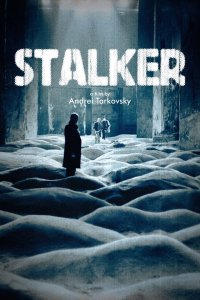
That last episode there were so many influences. Another big one for me for the Zone was – and this is going to sound quite random – Tarkovsky’s Stalker. It’s an absolute masterpiece, and obviously completely different in every way, but it’s about an area, a zone of some wasteland where there’s a stalker and it’s supposed to be a place where your dreams come true or you discover yourself.
What’s really amazing about that film is that The Zone itself is just a wasteland, it’s just some scrubby grass, a bit of a derelict building. There’s nothing actually special about it but the way it’s presented is so alive and so creepy and just has this tension. Just some waving grass has tension. It’s just an amazing film and I thought, ‘I want to do my own little version of that, in the ten minutes I have in episode 5.’
 I read a great book about abandoned places, Islands of Abandonment – Life in the Post-Human Landscape by Cal Flyn. She visits these places that no one has been in for years and years, for various reasons, and just writes about the experience. It’s a really beautiful book: the places are abandoned by humans and the natural world has taken it over.
With this series, it sounds like you were pretty sure that this is the middle eight of the piece, so to speak. Were you again consciously holding stuff back that could have gone in here?
Yes, there was stuff I held back. I knew that we had series 3 before I finished writing series 2 so that was very helpful. There was not as much stuff as I held back from series 1 because this was more planned. I knew exactly where I was getting to.
I think it was more within the series: I might have introduced some things earlier, in earlier episodes but I held off. I think that always happens because you have the whole thing in front of you and the temptation is to shove everything, the beginnings of everything, into episode 1 but then it just gets very muddled and you waste the story in some ways. There’s a bit of discipline in knowing when to hold back and think, ‘I’m not going there until episode 3.’
It’s the pacing, the crescendo. If you have all the brass playing in the first couple of bars you’ve not got anything held back to use later.
You do have to train yourself to and I certainly stripped some things out and thought ‘OK, I’ll simplify this and just wait and I’ll go there, later,’ I don’t have to touch on everything.
You recently went on a trip to the Arctic Circle. Have your experiences and what you saw during that made you think ‘Actually, Harland could go very slightly left here’?
 I think it will have an impact, yes. Definitely in terms of seeing in person the damage of climate change, that was really disturbing. And I think how in denial we are about it.
I mean, I was in denial. I flew there and I’m still struggling with that, since I’ve got home. I did think about it and I’d sort of rationalised it to myself but then going there and actually seeing it, I found it incredibly upsetting. Seeing the glaciers carving and hearing about how a few months ago the glaciers were this much further up the fjord than they are now.
I’m still processing it really but I’m sure it will impact it, especially as there is a undercurrent in Harland about climate catastrophe. I’m not quite sure how I’m going to look at that in series 3 but this definitely will have an impact. I’ve seen that it’s not theoretical. It was very disturbing; I was more disturbed than enchanted.
 Doctor Who News Star Trek News
