Prey: Interview: Amber Midthunder and Jhane Myers
Executive Producer Jhane Myers – an enrolled member of the Comanche nation as well as Blackfeet – came on board Prey early on, delighted at the prospect of a movie […]



Executive Producer Jhane Myers – an enrolled member of the Comanche nation as well as Blackfeet – came on board Prey early on, delighted at the prospect of a movie […]
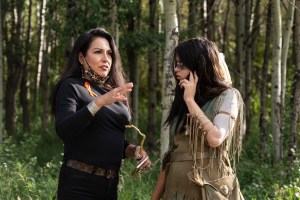 Executive Producer Jhane Myers – an enrolled member of the Comanche nation as well as Blackfeet – came on board Prey early on, delighted at the prospect of a movie that reflected Native culture properly. The film’s star, Amber Midthunder, is a member of the Fort Peck Sioux tribe. They chatted with Paul Simpson about the movie’s heritage…
I’ve had the privilege of working with the Autry Museum of the American West on a project about Indigenous matters and so this has been fascinating, looking at the background of how this all came about. What were both of your reactions when you first realised or read that this was going to be heavily involved with Indigenous culture?
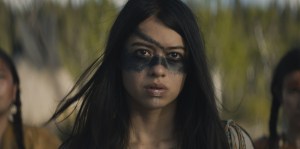 Amber: I didn’t know. My information was backwards. So when I auditioned for it, all that I knew was that it was a film about a young Comanche woman who wanted to be a hunter and roughly the time period – although I don’t know if that was set yet or if I knew that. Then way later, I found out it was a Predator movie, so that was a big adjustment the other way.
I think I went through the thoughts that everybody else went through, like ‘How’s that going to work? What happens in it? What is going on?’ By the time I read the script I was feeling the way everybody else did but, of course, then very excited grasping onto the idea of it.
Jhane: For me being a producer who happens to be Native, usually when I’m brought in to work on things with Native content, it’s 20% to 25% Native content. This film was 100%… 110% Native content. And not only was it just Native content, I’m an enrolled member of the Comanche Nation as well as Blackfeet so to see that it had my culture in it, oh my gosh, amazing. I knew I had to work on this project.
How much did it change from the version that you saw when you became involved to the final cut, in terms of the Native elements? What specifically was changed or refined?
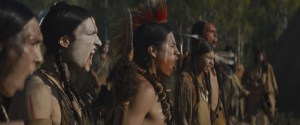 Jhane: For me, not a lot of it changed. I feel like I’m an expert in my culture because I’m also a fine artist. I’ve worked with the Autry as well and I’ve won some awards there when they have their Native art marketplace.
I actually felt like I infused some Native Comanche nuances in there, just our day to day stuff or things that we talk about, in story. But basically it was pretty well set, it just needed more of the hands-on which came in pre production, like working on the costuming using the earth paints that we used at that time and just developing a Comanche… not a handbook but I developed a book that went out to every department so they could get into that time period and see what our culture and our lives [were like] and what things looked like.
There are no pictures from that time and there are very few artefacts, so we had to do a lot of renderings. An artist that’s a very good friend of mine who researches cultures, was able to do some really great renderings for us too.
I would have thought that one of the major problems is that there isn’t a lot of material from 300 years ago. Are you extrapolating a lot or can you look at what’s happening in 2022 and go ‘We’ve been doing this for 500 years therefore in 1719 they must have been doing this’?
 Jhane: Well, we have a lot. Our nature is oral history so we have a lot of those stories that are passed down. Even how we refer to the Predator in the film, in Comanche we call it Pia mupitsi. Our words usually have two or three meanings, ‘pia’ can mean monster or ‘pia’ can mean big, so Pia mupitsi means big monster and when you get to how that monster is described it’s almost like the Predator. It’s this tall being that has tiny eyes that comes out at night, that was a story we used to scare children. ‘You’d better behave or we’re going to call Pia mupitsi’ or ‘Pia mupitsi is going to come and knock on the door.’ So, we had those things to go by which was fine.
You have to remember too this is an action sci fi film. It’s not a documentary. Sometimes we could take liberties – like with Amber’s regalia and the outfit she’s wearing because she has to be real physical and who knows? There may have been something like that in the 1700s but I don’t think we took a huge departure from culture.
We showed the film to the Comanches while it was still a work in progress and they were just blown away. We got a focus group of about 80 people and 84 people showed up which was amazing. They were blown away to have all the different components in a brand new film. Not only is it about Comanches but it’s about Comanches all the way though and we have a language component, everything was incredible.
And the way the French language treated as well makes a big difference. There was a very definite disconnect that we saw, particularly in the scenes towards the end when Amber, you’re with the hunters, where you understand their body language and what they’re doing but not necessarily what they’re saying to you.
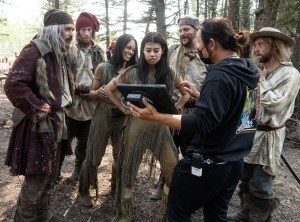 Amber: I don’t believe there will be subtitles on that because Dan, I think, was clear about wanting to create the perspective. That’s the idea with the language. Before we even started shooting, there was a conversation about shooting the movie entirely in Comanche or a mix of Comanche and English and originally there was a different opening scene. We shot that scene in both English and Comanche to have the option of ‘How do we establish in Comanche and then go into English? How is that going to work?’
Obviously now, the way that it is, is that basically when you’re hearing us speak English essentially, it’s like you speak Comanche. We’re speaking Comanche and you’re just listening. So when you hear another language and you don’t understand it, it’s through the Comanche perspective. I think that’s why there’s no subtitles on those things or even [for the] Comanche because it’s just a part of the world.
I’ve heard Dan say ‘What is foreign to her is foreign to you’ and to be in that perspective and give that experience as those people are the foreigners.
You’ve done quite a lot of genre work – the three that immediately come to mind are this, Legion and Roswell, which are all incredibly different. What were the specific challenges? Obviously physicality, I’m sure, but what were the other challenges of this for you as a role?
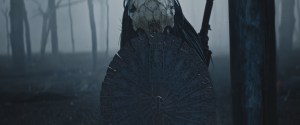 Amber: The big difference, to me, is the style of action. On Legion, it was a lot of martial arts and it was very clear about ‘OK, we’re mixing kung fu and taekwondo.’ Or ‘This year we’re doing swords,’ all that kind of focus work and it’s very clean.
This was far more on your toes and real, in the moment, thrown together, type of style. Obviously it was with Comanche fighting style as the overall umbrella but inside of that, early on Dan sent me a lot of references of Jackie Chan fights – obviously, just an incredible action artist – and though that is martial arts, the point was that there are some fights where you’re like ‘Oh look, he’s very caught off guard in this fight and that changes the physicality’ or ‘In this one he’s very prepared.’ That changes the dynamic of the fight and obviously a huge part of this movie was telling a story through action or just through body language when there’s no words.
So that, to me, is the big thing that I learned on this one – experiencing that different type of style. Even fight scenes that were choreographed, the fighting style was just so much more rugged.
Prey is streaming now on Disney+UK and Hulu in the US,
 Doctor Who News Star Trek News
 Sci-Fi Bulletin: Exploring the Universes of SF, Fantasy, Horror and Spy-fi!